


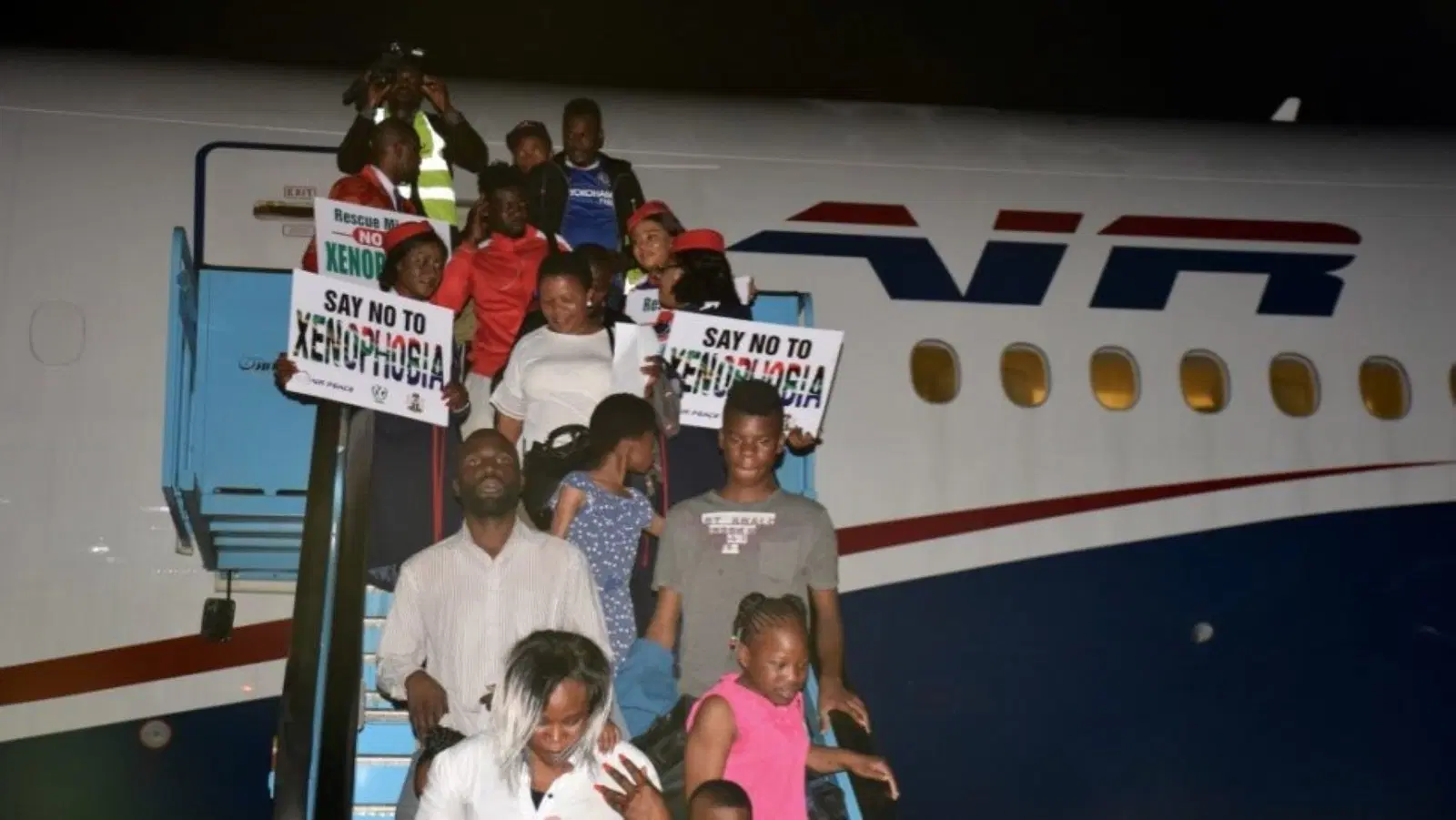
The Federal Government has announced plans to seek compensation from the South African government for Nigerians who were forced to abandon businesses, homes, vehicles and other valuable assets following the latest wave of anti-immigrant tensions in the country.
The move comes as another 269 Nigerians safely arrived in Lagos aboard the government’s latest evacuation flight, raising the total number of citizens repatriated to 603 since the emergency evacuation exercise began.
The returnees include 268 Nigerians airlifted by Air Peace on June 11, 66 evacuated by ValueJet in a subsequent operation, and the latest batch transported by Air Peace.
FG Begins Documentation of Abandoned Assets
Speaking on Channels Television’s The Morning Brief as the evacuees arrived in Lagos, Acting Nigerian High Commissioner to South Africa, Temitope Ajayi, disclosed that the Federal Government had begun compiling detailed records of businesses and properties abandoned by returning Nigerians.
According to him, the information will be used during discussions with South African authorities on possible compensation.
Ajayi explained that the issue had already been raised during a recent meeting with South Africa’s Deputy Minister of Finance, where both parties agreed that affected Nigerians should carefully document everything they were leaving behind.
He urged returnees to provide accurate records of their businesses, shops, vehicles, landed properties and other assets to enable Nigerian officials verify the locations with South African authorities before formally presenting compensation claims.
He stressed that the evacuation exercise would not end with bringing citizens home, noting that the government intends to pursue justice for Nigerians whose investments were lost because of the crisis.
Most Nigerians Entered South Africa Legally — Envoy
Ajayi also rejected claims that most Nigerians affected by the evacuation were undocumented migrants.
According to him, many Nigerians entered South Africa legally but became victims of prolonged delays in processing immigration documents at the country’s Home Affairs Department.
He explained that thousands of applications had remained unattended for years because of administrative challenges, leaving many migrants with expired permits despite following legal immigration procedures.
Ajayi argued that describing such individuals as undocumented was misleading, insisting they were caught in a dysfunctional immigration system rather than violating immigration laws.
603 Nigerians Evacuated, More Flights Planned
The latest evacuation formed part of five Air Peace flights approved by President Bola Ahmed Tinubu to bring home Nigerians affected by renewed xenophobic tensions.
The approval followed the screening and clearance of over 1,000 Nigerians by the Nigerian High Commission in Pretoria.
The returnees were received at the airport by senior officials of the Ministry of Foreign Affairs, led by Director of African Affairs, Ambassador Haruna Ali Gombe, who conveyed President Tinubu’s goodwill message and assured them of the government’s commitment to protecting Nigerians abroad.
In a statement, Foreign Affairs Ministry spokesperson Kimiebi Ebienfa said evacuation flights would continue beyond the June 30 deadline issued by South African authorities for undocumented migrants to leave the country.
He added that Nigeria would continue diplomatic engagement with Pretoria to ensure the safety and protection of Nigerians still residing in South Africa.
The ministry also advised Nigerians awaiting evacuation to remain calm, avoid protest flashpoints and maintain regular contact with the Nigerian High Commission for updates.
Protests Remain Peaceful Under Heavy Security
Meanwhile, Nigerians living in South Africa reported that the nationwide anti-immigrant demonstrations remained largely peaceful due to an unprecedented security deployment.
South African authorities mobilised about 13,000 law enforcement personnel, supported by helicopters, drones and more than 33,000 CCTV cameras across Gauteng Province to prevent a repeat of the deadly unrest experienced in 2021.
Officials reportedly budgeted about R600 million for the security operation amid fears that demonstrations organised by anti-illegal immigration group March and March could escalate into violence.
Businesses, freight operators and shopping centres also activated contingency measures across Gauteng, KwaZulu-Natal and the Western Cape over concerns about possible disruptions.
Businesses Shut, Residents Stay Indoors
A Nigerian resident in Johannesburg, identified simply as Madueke, said businesses remained closed while many residents stayed indoors because of fears that demonstrations could turn violent.
He noted, however, that the presence of military personnel accompanying protesters had prevented attacks on businesses and properties.
According to him, security forces successfully foiled attempts by some individuals to loot shops, particularly food stores.
Madueke appealed to the Nigerian government to deploy more evacuation flights, saying thousands of Nigerians were still waiting at the Nigerian High Commission in Pretoria to return home.
He argued that the five approved flights would only evacuate about 1,000 people, leaving many stranded despite their willingness to leave South Africa.
Law-Abiding Nigerians Cannot Be Forced Out — Igbo Union
Also speaking, National Secretary of Igbo Union South Africa, Ezeanozie Eleberi, confirmed that although demonstrations took place as scheduled, the situation remained calm because the South African government warned against violence.
Eleberi insisted that the majority of Nigerians living in South Africa are legal residents with businesses, families and significant investments, stressing that they cannot be forced out by pressure groups.
He said anti-immigrant campaigners were ordinary civilians without legal authority to expel foreigners from the country.
According to him, only about 1,500 Nigerians have so far volunteered for repatriation, while many others intend to remain because they have established legitimate lives and contributed meaningfully to South Africa’s economy.
Nigerian Associations Supporting Stranded Citizens
Eleberi disclosed that Nigerian community organisations had been working closely with the Nigerian High Commission to provide emergency support, including food, water and temporary accommodation for stranded nationals.
He explained that while some evacuees were sheltered within the High Commission in Pretoria, others received assistance from volunteers and members of the Nigerian community.
He advised Nigerians who remain in South Africa to stay alert, avoid criminal activities and steer clear of anti-foreigner demonstrations.
Nigeria to Demand Compensation From South Africa as Xenophobia Forces Nigerians to Abandon Businesses
The Federal Government has announced plans to seek compensation from the South African government for Nigerians who were forced to abandon businesses, homes, vehicles and other valuable assets following the latest wave of anti-immigrant tensions in the country.
The move comes as another 269 Nigerians safely arrived in Lagos aboard the government’s latest evacuation flight, raising the total number of citizens repatriated to 603 since the emergency evacuation exercise began.
The returnees include 268 Nigerians airlifted by Air Peace on June 11, 66 evacuated by ValueJet in a subsequent operation, and the latest batch transported by Air Peace.
FG Begins Documentation of Abandoned Assets
Speaking on Channels Television’s The Morning Brief as the evacuees arrived in Lagos, Acting Nigerian High Commissioner to South Africa, Temitope Ajayi, disclosed that the Federal Government had begun compiling detailed records of businesses and properties abandoned by returning Nigerians.
According to him, the information will be used during discussions with South African authorities on possible compensation.
Ajayi explained that the issue had already been raised during a recent meeting with South Africa’s Deputy Minister of Finance, where both parties agreed that affected Nigerians should carefully document everything they were leaving behind.
He urged returnees to provide accurate records of their businesses, shops, vehicles, landed properties and other assets to enable Nigerian officials verify the locations with South African authorities before formally presenting compensation claims.
He stressed that the evacuation exercise would not end with bringing citizens home, noting that the government intends to pursue justice for Nigerians whose investments were lost because of the crisis.
Most Nigerians Entered South Africa Legally — Envoy
Ajayi also rejected claims that most Nigerians affected by the evacuation were undocumented migrants.
According to him, many Nigerians entered South Africa legally but became victims of prolonged delays in processing immigration documents at the country’s Home Affairs Department.
He explained that thousands of applications had remained unattended for years because of administrative challenges, leaving many migrants with expired permits despite following legal immigration procedures.
Ajayi argued that describing such individuals as undocumented was misleading, insisting they were caught in a dysfunctional immigration system rather than violating immigration laws.
603 Nigerians Evacuated, More Flights Planned
The latest evacuation formed part of five Air Peace flights approved by President Bola Ahmed Tinubu to bring home Nigerians affected by renewed xenophobic tensions.
The approval followed the screening and clearance of over 1,000 Nigerians by the Nigerian High Commission in Pretoria.
The returnees were received at the airport by senior officials of the Ministry of Foreign Affairs, led by Director of African Affairs, Ambassador Haruna Ali Gombe, who conveyed President Tinubu’s goodwill message and assured them of the government’s commitment to protecting Nigerians abroad.
In a statement, Foreign Affairs Ministry spokesperson Kimiebi Ebienfa said evacuation flights would continue beyond the June 30 deadline issued by South African authorities for undocumented migrants to leave the country.
He added that Nigeria would continue diplomatic engagement with Pretoria to ensure the safety and protection of Nigerians still residing in South Africa.
The ministry also advised Nigerians awaiting evacuation to remain calm, avoid protest flashpoints and maintain regular contact with the Nigerian High Commission for updates.
Protests Remain Peaceful Under Heavy Security
Meanwhile, Nigerians living in South Africa reported that the nationwide anti-immigrant demonstrations remained largely peaceful due to an unprecedented security deployment.
South African authorities mobilised about 13,000 law enforcement personnel, supported by helicopters, drones and more than 33,000 CCTV cameras across Gauteng Province to prevent a repeat of the deadly unrest experienced in 2021.
Officials reportedly budgeted about R600 million for the security operation amid fears that demonstrations organised by anti-illegal immigration group March and March could escalate into violence.
Businesses, freight operators and shopping centres also activated contingency measures across Gauteng, KwaZulu-Natal and the Western Cape over concerns about possible disruptions.
Businesses Shut, Residents Stay Indoors
A Nigerian resident in Johannesburg, identified simply as Madueke, said businesses remained closed while many residents stayed indoors because of fears that demonstrations could turn violent.
He noted, however, that the presence of military personnel accompanying protesters had prevented attacks on businesses and properties.
According to him, security forces successfully foiled attempts by some individuals to loot shops, particularly food stores.
Madueke appealed to the Nigerian government to deploy more evacuation flights, saying thousands of Nigerians were still waiting at the Nigerian High Commission in Pretoria to return home.
He argued that the five approved flights would only evacuate about 1,000 people, leaving many stranded despite their willingness to leave South Africa.
Law-Abiding Nigerians Cannot Be Forced Out — Igbo Union
Also speaking, National Secretary of Igbo Union South Africa, Ezeanozie Eleberi, confirmed that although demonstrations took place as scheduled, the situation remained calm because the South African government warned against violence.
Eleberi insisted that the majority of Nigerians living in South Africa are legal residents with businesses, families and significant investments, stressing that they cannot be forced out by pressure groups.
He said anti-immigrant campaigners were ordinary civilians without legal authority to expel foreigners from the country.
According to him, only about 1,500 Nigerians have so far volunteered for repatriation, while many others intend to remain because they have established legitimate lives and contributed meaningfully to South Africa’s economy.
Nigerian Associations Supporting Stranded Citizens
Eleberi disclosed that Nigerian community organisations had been working closely with the Nigerian High Commission to provide emergency support, including food, water and temporary accommodation for stranded nationals.
He explained that while some evacuees were sheltered within the High Commission in Pretoria, others received assistance from volunteers and members of the Nigerian community.
He advised Nigerians who remain in South Africa to stay alert, avoid criminal activities and steer clear of anti-foreigner demonstrations.
Nigeria to Demand Compensation From South Africa as Xenophobia Forces Nigerians to Abandon Businesses
The Federal Government has announced plans to seek compensation from the South African government for Nigerians who were forced to abandon businesses, homes, vehicles and other valuable assets following the latest wave of anti-immigrant tensions in the country.
The move comes as another 269 Nigerians safely arrived in Lagos aboard the government’s latest evacuation flight, raising the total number of citizens repatriated to 603 since the emergency evacuation exercise began.
The returnees include 268 Nigerians airlifted by Air Peace on June 11, 66 evacuated by ValueJet in a subsequent operation, and the latest batch transported by Air Peace.
FG Begins Documentation of Abandoned Assets
Speaking on Channels Television’s The Morning Brief as the evacuees arrived in Lagos, Acting Nigerian High Commissioner to South Africa, Temitope Ajayi, disclosed that the Federal Government had begun compiling detailed records of businesses and properties abandoned by returning Nigerians.
According to him, the information will be used during discussions with South African authorities on possible compensation.
Ajayi explained that the issue had already been raised during a recent meeting with South Africa’s Deputy Minister of Finance, where both parties agreed that affected Nigerians should carefully document everything they were leaving behind.
He urged returnees to provide accurate records of their businesses, shops, vehicles, landed properties and other assets to enable Nigerian officials verify the locations with South African authorities before formally presenting compensation claims.
He stressed that the evacuation exercise would not end with bringing citizens home, noting that the government intends to pursue justice for Nigerians whose investments were lost because of the crisis.
Most Nigerians Entered South Africa Legally — Envoy
Ajayi also rejected claims that most Nigerians affected by the evacuation were undocumented migrants.
According to him, many Nigerians entered South Africa legally but became victims of prolonged delays in processing immigration documents at the country’s Home Affairs Department.
He explained that thousands of applications had remained unattended for years because of administrative challenges, leaving many migrants with expired permits despite following legal immigration procedures.
Ajayi argued that describing such individuals as undocumented was misleading, insisting they were caught in a dysfunctional immigration system rather than violating immigration laws.
603 Nigerians Evacuated, More Flights Planned
The latest evacuation formed part of five Air Peace flights approved by President Bola Ahmed Tinubu to bring home Nigerians affected by renewed xenophobic tensions.
The approval followed the screening and clearance of over 1,000 Nigerians by the Nigerian High Commission in Pretoria.
The returnees were received at the airport by senior officials of the Ministry of Foreign Affairs, led by Director of African Affairs, Ambassador Haruna Ali Gombe, who conveyed President Tinubu’s goodwill message and assured them of the government’s commitment to protecting Nigerians abroad.
In a statement, Foreign Affairs Ministry spokesperson Kimiebi Ebienfa said evacuation flights would continue beyond the June 30 deadline issued by South African authorities for undocumented migrants to leave the country.
He added that Nigeria would continue diplomatic engagement with Pretoria to ensure the safety and protection of Nigerians still residing in South Africa.
The ministry also advised Nigerians awaiting evacuation to remain calm, avoid protest flashpoints and maintain regular contact with the Nigerian High Commission for updates.
Protests Remain Peaceful Under Heavy Security
Meanwhile, Nigerians living in South Africa reported that the nationwide anti-immigrant demonstrations remained largely peaceful due to an unprecedented security deployment.
South African authorities mobilised about 13,000 law enforcement personnel, supported by helicopters, drones and more than 33,000 CCTV cameras across Gauteng Province to prevent a repeat of the deadly unrest experienced in 2021.
Officials reportedly budgeted about R600 million for the security operation amid fears that demonstrations organised by anti-illegal immigration group March and March could escalate into violence.
Businesses, freight operators and shopping centres also activated contingency measures across Gauteng, KwaZulu-Natal and the Western Cape over concerns about possible disruptions.
Businesses Shut, Residents Stay Indoors
A Nigerian resident in Johannesburg, identified simply as Madueke, said businesses remained closed while many residents stayed indoors because of fears that demonstrations could turn violent.
He noted, however, that the presence of military personnel accompanying protesters had prevented attacks on businesses and properties.
According to him, security forces successfully foiled attempts by some individuals to loot shops, particularly food stores.
Madueke appealed to the Nigerian government to deploy more evacuation flights, saying thousands of Nigerians were still waiting at the Nigerian High Commission in Pretoria to return home.
He argued that the five approved flights would only evacuate about 1,000 people, leaving many stranded despite their willingness to leave South Africa.
Law-Abiding Nigerians Cannot Be Forced Out — Igbo Union
Also speaking, National Secretary of Igbo Union South Africa, Ezeanozie Eleberi, confirmed that although demonstrations took place as scheduled, the situation remained calm because the South African government warned against violence.
Eleberi insisted that the majority of Nigerians living in South Africa are legal residents with businesses, families and significant investments, stressing that they cannot be forced out by pressure groups.
He said anti-immigrant campaigners were ordinary civilians without legal authority to expel foreigners from the country.
According to him, only about 1,500 Nigerians have so far volunteered for repatriation, while many others intend to remain because they have established legitimate lives and contributed meaningfully to South Africa’s economy.
Nigerian Associations Supporting Stranded Citizens
Eleberi disclosed that Nigerian community organisations had been working closely with the Nigerian High Commission to provide emergency support, including food, water and temporary accommodation for stranded nationals.
He explained that while some evacuees were sheltered within the High Commission in Pretoria, others received assistance from volunteers and members of the Nigerian community.
He advised Nigerians who remain in South Africa to stay alert, avoid criminal activities and steer clear of anti-foreigner demonstrations.
Immigration System Blamed for Documentation Crisis
Reacting to suggestions that many repatriated Nigerians lacked valid immigration documents, Eleberi blamed South Africa’s Home Affairs system for failing to process permit renewal applications.
He acknowledged that some foreigners may have overstayed their visas or entered the country through irregular routes but insisted that many Nigerians became undocumented because authorities failed to renew permits despite receiving applications.
He added that attention should also be given to the thousands of Nigerians legally living and working in South Africa, many of whom own businesses and create employment opportunities for South Africans.
Eleberi maintained that while some Nigerians had chosen to return home due to the worsening situation, many others remain committed to staying because of their deep economic and family ties in the country.
Immigration System Blamed for Documentation Crisis
Reacting to suggestions that many repatriated Nigerians lacked valid immigration documents, Eleberi blamed South Africa’s Home Affairs system for failing to process permit renewal applications.
He acknowledged that some foreigners may have overstayed their visas or entered the country through irregular routes but insisted that many Nigerians became undocumented because authorities failed to renew permits despite receiving applications.
He added that attention should also be given to the thousands of Nigerians legally living and working in South Africa, many of whom own businesses and create employment opportunities for South Africans.
Eleberi maintained that while some Nigerians had chosen to return home due to the worsening situation, many others remain committed to staying because of their deep economic and family ties in the country.
Immigration System Blamed for Documentation Crisis
Reacting to suggestions that many repatriated Nigerians lacked valid immigration documents, Eleberi blamed South Africa’s Home Affairs system for failing to process permit renewal applications.
He acknowledged that some foreigners may have overstayed their visas or entered the country through irregular routes but insisted that many Nigerians became undocumented because authorities failed to renew permits despite receiving applications.
He added that attention should also be given to the thousands of Nigerians legally living and working in South Africa, many of whom own businesses and create employment opportunities for South Africans.
Eleberi maintained that while some Nigerians had chosen to return home due to the worsening situation, many others remain committed to staying because of their deep economic and family ties in the country.


