


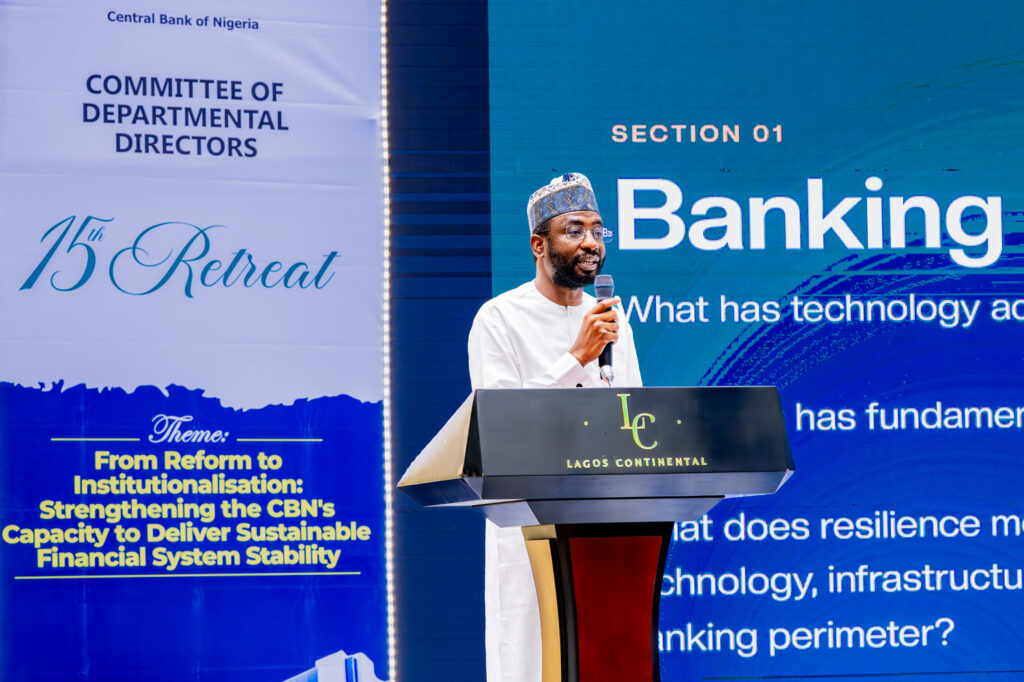
LAGOS: The Director-General of the National Information Technology Development Agency (NITDA), Kashifu Inuwa Abdullahi, has said Nigeria’s financial stability can no longer be guaranteed through traditional regulatory approaches, stressing the need for stronger digital stability, real-time supervision and greater control of critical digital infrastructure.
Inuwa made the remarks while speaking on Digital Transformation, Supervision, Innovation and Operational Resilience at the 15th Retreat of the Central Bank of Nigeria (CBN) Committee of Departmental Directors in Lagos.
The retreat, themed From Reform to Institutionalisation: Strengthening the CBN Capacity to Deliver Sustainable Financial System Stability,brought together seniorCBN directors to examine emerging risks and strategies for strengthening the country’s financial system.
According to the NITDA chief, the rapid transformation of financial services—from physical banking branches to internet and mobile banking, fintech platforms and embedded financial services—has created a complex digital ecosystem that traditional supervisory models can no longer adequately monitor.
He said regulators must expand their focus beyond individual financial institutions to the wider technology ecosystem supporting the sector.
This includes telecommunications infrastructure, cloud platforms, fintech companies, digital marketplaces, data systems and emerging technologies.
To achieve financial stability, we need digital stability. Without digital stability, today we cannot be talking about financial stability in the financial sector,” Inuwa said.
Inuwa called on financial regulators to develop real-time visibility across the financial ecosystem rather than relying largely on periodic reports submitted by regulated institutions.
He argued that regulators must be able to identify emerging threats before they become systemic problems.
We need to be ahead of the institutions we regulate. We cannot wait for regulated institutions to submit returns before we analyse and understand what is happening. We need end-to-end visibility of the ecosystem,” he said.
The NITDA DG also distinguished between digitalisation and digital transformation.
While digitalisation involves using technology to improve existing processes, he explained that digital transformation goes further by creating new value propositions, business models and operating structures.
He therefore urged financial institutions and regulators to adopt ecosystem-driven innovation and continuously rethink their operating models as technology evolves.
Inuwa said operational resilience must now extend beyond conventional cybersecurity measures.
According to him, financial institutions and regulators must pay greater attention to third-party and fourth-party risks, cloud governance, data protection, artificial intelligence oversight and the sustainability of critical digital infrastructure.
He identified Nigeria’s growing dependence on external technology providers as a significant emerging risk.
A disruption affecting cloud services, connectivity infrastructure or major digital platforms, he warned, could have consequences across the wider financial ecosystem.
The NITDA DG also highlighted the growing threat posed by artificial intelligence-powered cyberattacks.
While AI can significantly strengthen cyber defence, he said the technology itself must be protected against manipulation, exploitation and increasingly sophisticated attacks.
He further stressed the need to develop local digital skills and institutional capacity to support technology-driven supervision and strengthen Nigeria’s long-term financial resilience.
Digital sovereignty critical to financial stability
Inuwa linked financial stability directly to digital sovereignty, arguing that Nigeria must maintain meaningful control over the critical digital infrastructure underpinning strategic sectors of the economy.
Financial stability now depends on resilient technology and Nigeria’s capacity for digital self-determination, he said.
He questioned how the country could guarantee the integrity and stability of its financial system without building, controlling and maintaining critical digital infrastructure.
The NITDA DG said the future of financial regulation would require a system-wide approach that allows regulators to identify and respond to risks across technologies, platforms, infrastructure and stakeholders.
He said the objective should not simply be to digitise regulation but to transform the way regulators detect, understand and respond to risks.
The future of supervision is not merely to digitise regulation, but to digitally transform how regulators sense, understand and respond to risks across the ecosystem,” Inuwa stated.
He added that such an approach would help Nigeria build a more resilient, secure and sustainable financial system capable of supporting its digital economy ambitions.
Speaking virtually at the retreat, CBN Governor Olayemi Cardoso assured staff that the apex bank was in a strong position following ongoing institutional reforms.
Cardoso said the Bank’s transformation agenda was designed to strengthen the institution while protecting the interests, professionalism and career progression of its workforce. The Bank is in a good place,” the governor said, urging employees to remain confident in the institution’s future.
He said the ultimate measure of successful reform would be its ability to become embedded in the CBN’s culture, systems and processes beyond the tenure of the officials responsible for initiating the reforms.
Cardoso also highlighted progress recorded by the Bank, including the completion of a bank-wide culture survey that allowed employees to contribute to shaping the institution’s future.
He described organisational culture as the foundation of sustainable institutional reform and pledged that staff feedback would continue to inform the Bank’s actions.
The governor also commended CBN employees following the Bank’s recent international recognition, saying the achievement reflected the dedication and professionalism of its workforce.
He urged directors to empower their teams, promote constructive engagement and strengthen collaboration across departments. Reform and institutionalisatioare not a threat to the career officer; they are the protection of the career officer,” Cardoso said.
The Chairman of the CBN Committee of Departmental Directors, Jimoh Musa Itoba, urged directors to take greater responsibility for strengthening financial stability and supporting Nigeria’s economic growth.
Describing the directors as the Bank’s “major anchors,” Itoba said they were custodians of the institution’s processes, culture and institutional memory.
He said the retreat provided an opportunity for participants to examine the CBN’s contribution to national economic development and Nigeria’s ambition of becoming a trillion-dollar economy.
Itoba challenged the directors to question existing assumptions and develop practical solutions that management could implement to strengthen financial system stability and public confidence.
He also called for greater collaboration and commitment among directors and other CBN officials.
Earlier, the Secretary of the Committee of Departmental Directors, Rashida Monguno, urged participants to embrace innovation, strategic thinking and collaboration as the CBN responds to an increasingly complex operating environment.
Monguno said the pace of technological and economic change required continuous performance assessment and new approaches to improving institutional effectiveness and service delivery.
She described the retreat’s theme as timely, saying the CBN must continually evaluate its progress, identify institutional gaps and develop innovative responses to emerging challenges.
She encouraged directors to leverage their collective expertise and experience to share best practices and develop practical recommendations for the Bank’s future.
According to her, the success of the CBN’s initiatives would depend on collaboration, strategic thinking and a sustained focus on measurable outcomes.
Monguno expressed confidence that the retreat would generate recommendations capable of strengthening institutional performance and improving coordination across departments.
The discussions at the retreat underscore the growing relationship between Nigeria’s financial system and its digital infrastructure.
As banking, payments and financial services become increasingly dependent on cloud computing, telecommunications networks, fintech platforms, artificial intelligence and data systems, disruptions in the digital ecosystem could increasingly translate into financial risks.
For Nigeria, strengthening digital stability, cybersecurity, operational resilience and digital sovereignty will therefore be critical to protecting the financial system and supporting the country’s broader digital economy ambitions.
Category: Technology / Business / Finance
Tags: NITDA, Kashifu Inuwa Abdullahi, CBN, Olayemi Cardoso, digital stability, digital transformation, financial stability, digital sovereignty, cybersecurity, fintech, Nigeria digital economy.