


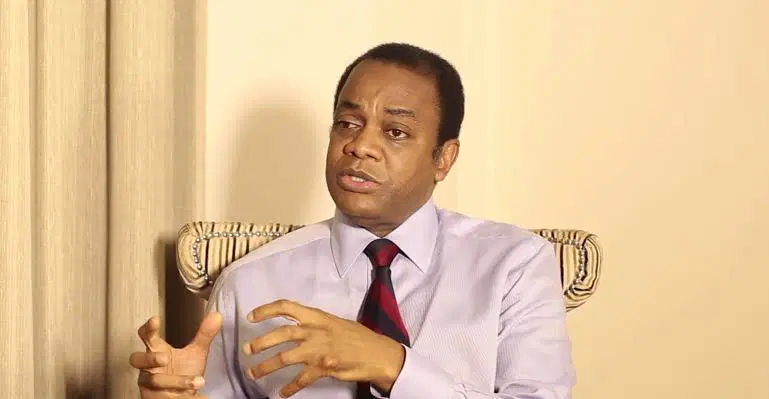
CALABAR: Former Cross River State Governor and Peoples Redemption Party (PRP) presidential candidate Donald Duke has argued that Nigeria’s economic growth has failed to keep pace with the country’s rapidly expanding population, linking persistent poverty, insecurity and social tensions to what he described as decades of weak productivity.
Duke made the remarks in Abuja while discussing Nigeria’s economic challenges, governance and the priorities he believes should guide public spending.
According to him, Nigeria’s population has risen from roughly 76 million during the Second Republic to an estimated 230 million today, while government spending and productive capacity have not expanded proportionately.
Duke said the Federal Government under former President Shehu Shagari operated with an average annual budget of about $25 billion between 1979 and 1983.
He argued that, despite the significant increase in Nigeria’s population since then, the country’s present spending power, when viewed in dollar terms, does not represent the kind of expansion he believes should have occurred.
Duke said the comparison showed that Nigeria had failed to achieve sufficient growth in productive capacity.
He argued that the nominal size of current budgets, when converted to dollars, did not tell the full story because the value of money has changed significantly over the decades.
His broader point was that Nigeria needed to measure economic progress by improvements in productivity and living standards rather than simply by the size of government budgets.
Duke attributed several of Nigeria’s socioeconomic challenges to what he described as inadequate productivity.
He said poverty, unemployment, insecurity and the rising cost of living were symptoms of a deeper failure to create an environment in which citizens and businesses could operate productively.
According to him, government’s responsibility should include providing security, effective institutions and an orderly environment that allows citizens to create wealth.
He argued that if Nigerians had adequate access to opportunities and essential services, ethnic, religious and regional considerations would have less influence over their political choices.
The former governor also renewed his criticism of the Lagos-Calabar Coastal Highway, questioning whether the project should take priority over other infrastructure and social needs.
Duke argued that government should assess major infrastructure projects according to their economic returns and opportunity costs.
He questioned the relationship between the coastal highway and existing roads, including the East-West Road, and asked whether scarce public resources could produce greater economic and social benefits if directed elsewhere.
Duke acknowledged that he could personally benefit from the highway because of his connections to Lagos and Calabar but maintained that personal convenience should not determine national spending priorities.
His criticism of the project is not new. In August, he described the highway as a misplaced priority and said Nigeria could not afford it under its current economic circumstances.
Duke’s position has previously drawn responses from the Federal Government.
Minister of Works David Umahi said in August that construction of the Lagos-Calabar Coastal Highway had already progressed beyond Epe, contrary to Duke’s earlier suggestion that the project might not extend beyond the Lagos area.
Umahi said work was ongoing in several states, including Ogun, Ondo and Cross River.
The Presidency also rejected Duke’s criticism of the project, saying construction was progressing beyond Lagos.
Duke pointed to Nigeria’s education challenges and the large number of people living in poverty as areas requiring substantial government attention.
He questioned the wisdom of committing large amounts of public resources to major infrastructure while basic needs such as education, healthcare, electricity and security remain pressing concerns.
His argument was that public investment should ultimately contribute to improving human capital and increasing the productive capacity of Nigerians.
The former governor also offered an explanation for Nigeria’s persistent ethnic, religious and regional tensions.
He argued that Nigerians often turn to ethnic or regional identities because they believe such affiliations can improve their access to scarce opportunities.
According to Duke, citizens would be less concerned about the ethnic or regional background of political leaders if government institutions consistently provided equal access to opportunities and services.
He illustrated the point by comparing political preferences with the choice of a doctor, arguing that people seeking medical treatment generally prioritise competence and results rather than the doctor’s place of origin.
Duke said Nigeria needed a clearer long-term national development strategy capable of connecting government spending with productivity, education, infrastructure and economic growth.
He argued that governments should avoid making decisions based solely on what appears important at a particular moment and instead develop policies around measurable national objectives.
His comments come as Nigeria continues to debate how best to balance infrastructure spending, social investment, debt obligations, economic growth and the needs of a rapidly expanding population.
Duke has also recently raised concerns about the state of Nigeria’s political system ahead of the 2027 elections. In an earlier September appearance, he alleged that desperation for political power had reached dangerous levels and warned about possible violence. Those claims were reported as allegations by media outlets and were not accompanied by identification of specific politicians involved.


