


LAGOS: Nigeria’s President, Bola Tinubu, has pledged to intensify his administration’s efforts to tackle insecurity across the country, stressing that peace and safety remain critical to national development.
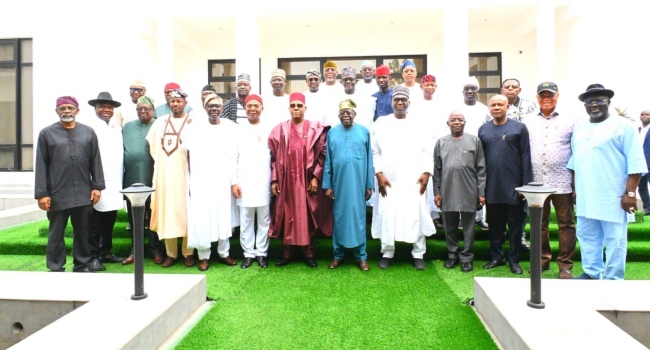
The President made the commitment on Sunday while hosting Vice President Kashim Shettima and 23 state governors at his residence in Lagos as part of celebrations marking Eid-el-Fitr.
Tinubu noted that the growing threat of insecurity remains one of the biggest obstacles to economic growth and prosperity in Nigeria, assuring the governors that his administration is strengthening both local and international partnerships to confront the challenge.
Speaking during the gathering, Tinubu praised the governors for their presence and commitment to national unity, noting that collective efforts are required to defeat criminal elements threatening the country’s stability.
According to a statement issued by his spokesman, Bayo Onanuga, the President emphasised that the next phase of Nigeria’s national struggle would focus heavily on confronting insecurity.
Insecurity is an enemy of development, progress and prosperity, Tinubu said.
The next phase of our struggle is staring us in the face, and that is the challenge of insecurity in the country.
I am making every effort to ensure that we collectively share the joy of victory over tyranny.
He explained that his administration is expanding international cooperation to strengthen Nigeria’s security capabilities, particularly in terms of military equipment and strategic support.
Tinubu disclosed that discussions on security cooperation formed part of his engagements during his recent visit to the United Kingdom.
According to him, the Nigerian government is also working closely with several global partners to boost its security architecture.
The President revealed that he recently held extensive talks with Emmanuel Macron, the President of France, on possible collaboration involving security equipment and operational support.
One of the major discussions in the United Kingdom was on equipment and support,” Tinubu said.
I can report that I also had a lengthy discussion with President Emmanuel Macron. They are collaborating with us for equipment and support, and I am making frantic efforts to contact other nations.
Tinubu also warned that the ongoing crisis in the Middle East could worsen inflationary pressures in Nigeria, particularly through rising energy and transportation costs.
The President urged state governors to pay closer attention to the needs of vulnerable Nigerians who may be most affected by the economic ripple effects of global instability.
We should care more for the vulnerable, he told the governors.
I know this Middle East crisis will spike inflation and affect our purchasing power. Labour unions and other groups may begin to demand more support because of the effect of the war and crisis.
Nigeria has recently witnessed a surge in the cost of petrol, with prices climbing to around ₦1,300 per litre in many parts of the country, further intensifying economic pressure on households.
Tinubu therefore advised the governors to introduce policies and incentives that would cushion the impact of rising costs on citizens.
The President further urged the governors to remain focused on implementing policies that directly improve the living conditions of Nigerians.
He encouraged them to remain resilient in turning their ideas and development plans into programmes that positively impact citizens.
Tinubu also called on the governors to support the federal government’s efforts to combat criminality and restore lasting security across the country.
Responding on behalf of the governors, the Chairman of the Nigeria Governors’ Forum and Governor of Kwara State, AbdulRahman AbdulRazaq, expressed appreciation to the President for his continued engagement with state governments.
He said the governors remain committed to working with the federal government to address the country’s security challenges.
AbdulRazaq also noted that discussions are ongoing on the creation of state police, a proposal many stakeholders believe could strengthen security at the grassroots level.
“Together, we must see that the issue of insecurity comes to an end,” he said.
“Regarding state police, discussions are ongoing with security agencies led by the National Security Adviser, and the Nigeria Governors’ Forum has made its contributions. The document will be presented to the National Assembly to establish the necessary legislative framework.
Among the governors who attended the gathering were Hope Uzodinma of Imo State, Alex Otti of Abia State, Umo Eno of Akwa Ibom State, and Douye Diri of Bayelsa State.
Others included Hyacinth Alia (Benue), Bassey Otu (Cross River), Sheriff Oborevwori (Delta), Francis Nwifuru (Ebonyi), Monday Okpebholo (Edo), and Peter Mbah (Enugu).
Also present were Abba Yusuf (Kano), Dikko Radda (Katsina), Usman Ododo (Kogi), Babajide Sanwo-Olu (Lagos), Abdullahi Sule (Nasarawa), Caleb Mutfwang (Plateau), Siminalayi Fubara (Rivers), Agbu Kefas (Taraba), Mai Mala Buni (Yobe), and Lucky Aiyedatiwa (Ondo).
The Deputy Governor of Borno State, Umar Kadafur, also attended the meeting.
The gathering highlighted the growing cooperation between the federal government and state governments as Nigeria confronts rising security threats and economic pressures.
Analysts say the discussions on security reforms, including the proposal for state police, may shape the country’s policy direction in the coming months as authorities intensify efforts to restore peace and stability nationwide.