


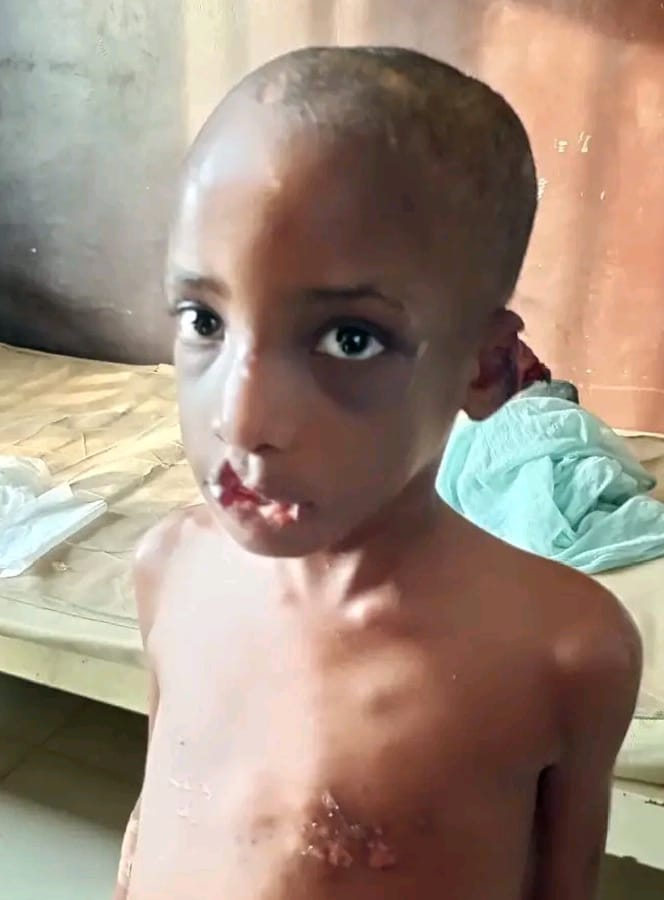
AGBOR: A civil rights organization, Talakwas Parliament, Delta State Chapter, has accused the Delta State Government of gross negligence and administrative failure over its handling of the case of a young girl allegedly mutilated by her stepmother in Agbor, Ika South Local Government Area.
The group alleged that despite taking custody of the abused child and her sibling, the state government failed to provide urgent medical care, particularly the plastic surgery required by the younger victim, while also blocking continued assistance from private individuals and non-governmental organizations willing to fund the child’s treatment and welfare.
Addressing journalists in Agbor on Wednesday, January 14, 2026, the Delta State Coordinator of Talakwas Parliament, Comrade Aghatise Raphael, expressed deep concern over what he described as the disturbing mishandling of the welfare, protection, and medical needs of two minor girls, aged eight and ten, who were allegedly subjected to prolonged abuse by their stepmother.
According to the group, graphic images of the abused children circulated on social media on December 5, 2025, triggering widespread outrage and an outpouring of compassion from Nigerians at home and abroad.
Individuals, faith-based organizations, and civil society groups reportedly donated funds, food items, medical supplies, and pledged long-term support for the children’s feeding, education, psychosocial care, and general wellbeing.
Talakwas Parliament disclosed that several volunteers offered to fully sponsor the urgent plastic surgery required by the younger child, identified as Uriel, while others committed to taking responsibility for the children’s upkeep.
The group said the Delta State Government later intervened and assumed custody of the children through the Ministry of Women Affairs, Community and Social Development—an action initially welcomed by the public.
However, Talakwas Parliament alleged that the intervention soon raised serious concerns, as donors and support organizations were allegedly prevented from continuing their assistance, even though the government had no clear plan or resources in place to meet the children’s needs.
The children were reportedly transferred from a hospital where donations and care were consistent to a government hospital in Asaba. Access to them was restricted, including access by individuals and organizations that had been funding their treatment.
While the restrictions were initially assumed to be for the children’s safety and psychological wellbeing, the group said this assumption collapsed when the children allegedly ran out of food shortly after relocation, having exhausted donations left at the previous hospital.
Talakwas Parliament revealed that it formally wrote to the Commissioner for Women Affairs on December 17, 2025, warning that nearly two weeks after taking custody, the ministry had not provided funds for feeding, medical care, or general welfare.
A meeting held the following day with the Permanent Secretary of the ministry allegedly confirmed that no structured welfare mechanism had been established and that no government funding had been released for the children.
Faced with the situation, the group said it appealed to the Knights of St. John, Agbor Commandery of which the children’s late mother was a member to continue financial support.
According to the group, the organization, alongside concerned citizens, provided regular assistance to keep the children fed and cared for.
Talakwas Parliament said public expectations were that the government would, at a minimum, facilitate the promised plastic surgery for the younger child.
It therefore came as a rude shock, the group stated, to learn on January 9, 2026, that the children were discharged from the government hospital without the surgery and handed over to their maternal family without public explanation, documented safeguards, or a disclosed medical plan.”
The group said the decision raised serious questions about child protection, continuity of care, and the government’s commitment to the children’s best interests.
Talakwas Parliament reminded the state government that Section 17(3)(d) of the 1999 Constitution (as amended) obligates the state to safeguard the welfare of citizens, particularly vulnerable children.
The group also cited the Child Rights Act, 2003, as domesticated in Delta State, which guarantees every child the right to protection, healthcare, and development, and places the child’s best interest above political or administrative considerations.
The organization called on the Commissioner for Women Affairs, Hon. Pat Ajudia, to publicly clarify several issues, including:
-
Whether Delta State lacks qualified plastic surgeons, and if not, why the child was discharged without surgery
-
If government funding was unavailable, why willing donors were prevented from providing assistance
-
Whether any funds were released for the children’s feeding and welfare during their approximately 32 days in government custody, and details of such disbursements
-
The justification for releasing the children to their maternal family, which reportedly made no financial contribution during hospitalization
-
Whether a proper home and environmental assessment was conducted prior to their release
-
Whether any formal agreement or timeline exists for the pending surgery
-
What monitoring and protection mechanisms are currently in place to ensure the children’s safety
In addition, the group demanded the publication of a comprehensive report detailing all actions taken by the ministry, including custody timelines, medical interventions, welfare expenditures, and responsible officials.
They also called for the establishment of an independent investigative or administrative review panel to examine the handling of the case, with its findings made public.
Talakwas Parliament stressed that child protection must not be reduced to a public relations exercise, but treated as a constitutional, statutory, and moral obligation.
The group warned that the handling of the case raises serious concerns about accountability, transparency, and the sincerity of the state government’s commitment to protecting vulnerable children.
It urged the Commissioner for Women Affairs to address the issues urgently and transparently, warning that history would judge the administration of Governor Sheriff Oborevwori by how it treats its most vulnerable citizens.
The dignity, welfare, and future of abused children must never be sacrificed on the altar of political convenience,” the group concluded.