


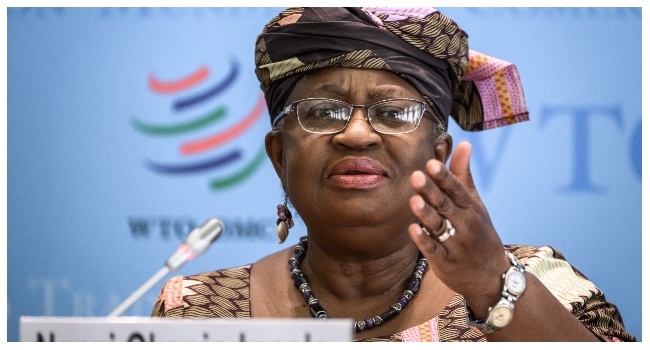
The Director-General of the World Trade Organization, Ngozi Okonjo-Iweala, has called on the Federal Government to prioritise the upgrading and maintenance of Nigeria’s airport infrastructure to strengthen the country’s aviation sector and improve its global competitiveness.
She made the call on Wednesday while speaking at the Aircraft Acquisition and Investment Summit held in Lagos, stressing that improving aviation infrastructure is essential for Nigeria to move up the global economic value chain.
According to Okonjo-Iweala, a country seeking stronger integration into global trade and investment networks must develop modern aviation facilities capable of supporting international standards.
For a country like Nigeria that wants to move up the global value chain, upgrading and maintaining existing airport infrastructure is not optional but a prerequisite,” she said.
She emphasised that strengthening the aviation ecosystem requires not only the acquisition of new aircraft but also sustained investment in airport infrastructure and maintenance culture.
Okonjo-Iweala also encouraged the government to explore public-private partnerships as a strategy for financing major aviation projects, noting that government resources alone may not be sufficient to meet the sector’s infrastructure demands.
“The good news is that the burden need not be borne by government alone. This calls for public-private partnerships. Private financing needs to be mobilized for the modernization of airport infrastructure, she said.
She explained that in such partnerships, the government would provide a stable regulatory environment and long-term concession structures, while private investors would contribute capital, operational expertise and efficiency.
The model is straightforward government provides the enabling framework, regulatory certainty and long-term concession structures that give the private sector confidence to commit, she noted.
According to her, once such structures are in place, Nigeria could witness the kind of commercial growth experienced in other aviation markets across the world.
Okonjo-Iweala also raised concerns about the rising operational costs facing airlines in Nigeria, urging authorities to review existing fuel costs, airport taxes, levies and charges that could hinder the growth of the sector.
“The full costs need to be reexamined — fuel costs, airport taxes, levies and charges,” she said, adding that creating a favourable business environment is critical to attracting both local and international investors.
She further advised the government to maintain a fair and competitive tax regime while advancing market liberalisation policies that allow greater access to international routes.
Okonjo-Iweala suggested that Nigeria should also work with other African countries to eliminate bilateral restrictions that limit where African airlines can operate, thereby expanding regional connectivity.
“Most importantly, government must see the aviation sector as a strategic economic enabler rather than a revenue source that needs to be extracted,” she added.
While acknowledging improvements in Nigeria’s aviation safety record over the past two decades, Okonjo-Iweala noted that more progress is still required, particularly in expanding and upgrading airline fleets.
“The Nigerian air transportation sector has grown in recent years with the emergence of private airlines and the development of new airports and related infrastructure,” she said.
“The safety records have also improved in the last 20 years, but there is still a long distance to cover. Existing airlines need to upgrade and expand their fleets.”
Nigeria’s aviation sector remains an important contributor to the national economy, generating an estimated $1.7 billion to $2.5 billion annually to the country’s Gross Domestic Product.
However, the industry continues to face several structural challenges, including high operational costs, infrastructure deficits and rising aviation fuel prices.
The cost of aviation fuel has risen sharply in recent months, largely due to the ongoing geopolitical tensions in the Middle East.
The price of aviation fuel increased by about 184 per cent in two months, rising from approximately ₦900 per litre in January to about ₦2,557 per litre.
Industry data indicate that aviation fuel alone accounts for about 40 per cent of airline operating expenses, making it the single largest cost for most operators. Aircraft maintenance is the next major expenditure.
Stakeholders say that addressing these challenges through improved infrastructure, regulatory reforms and investment partnerships could significantly boost the sector’s contribution to Nigeria’s economy while enhancing connectivity across Africa and the rest of the world.