


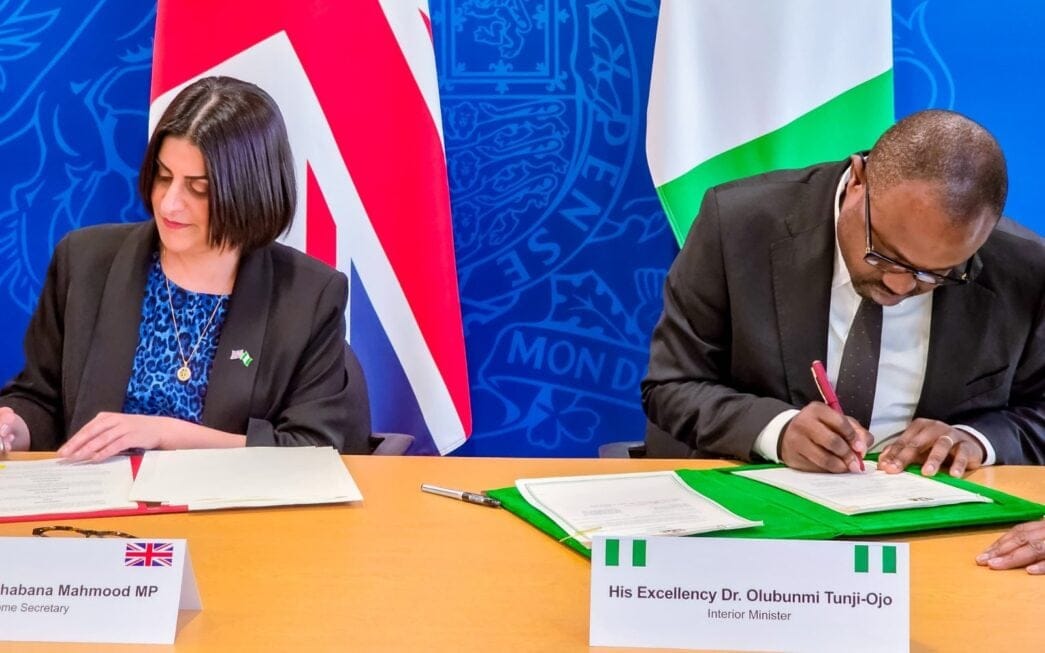
The Federal Government of Nigeria has reached an agreement with the United Kingdom to accept deported criminals and failed asylum seekers, in a move aimed at strengthening cooperation between both countries on migration management and border security.
The deal was finalised during the state visit of Bola Ahmed Tinubu to Britain and forms part of broader discussions on immigration control, security collaboration and diplomatic relations between the two countries.
The agreement was signed by Nigeria’s Minister of Interior, Olubunmi Tunji-Ojo, and the UK Home Secretary, Shabana Mahmood, according to a statement released by the Home Office on Thursday.
Under the arrangement, Nigeria has agreed to receive individuals deported from the UK who are either convicted criminals, failed asylum seekers or people who have overstayed their visas.
Officials say the agreement introduces new procedures that will make deportations easier and faster for British authorities.
One key provision allows the UK to use official UK letters; documents issued to individuals who do not possess valid passports—as a recognised form of identification.
This means deportees will no longer need to wait for emergency travel documents to be processed before they can be returned to Nigeria, potentially speeding up removal procedures.
British authorities say the deal is part of ongoing efforts to tighten migration controls and ensure individuals who violate immigration laws are returned to their home countries more efficiently.
Alex Norris, who signed aspects of the agreement on behalf of the British government, described Nigeria as a crucial partner in addressing illegal migration.
“Nigeria is a key partner in our work to tackle illegal migration, as the UK’s largest African visa market and home to thousands of Nigerians who have built their lives here,” Norris said.
He stressed that the British government remains determined to maintain order within its immigration system.
“Anyone who abuses our systems, breaks our laws, or tries to cheat their way into Britain will be stopped and removed, he said.
Norris added that the agreement represents another step in the UK government’s efforts to strengthen border enforcement and ensure individuals without legal residency rights are removed swiftly.
According to British officials, deportations and returns of illegal migrants and foreign criminals from the UK have reached nearly 60,000 since the 2024 general election, with annual returns to Nigeria rising significantly.
Recent figures indicate that deportations to Nigeria have nearly doubled, reaching about 1,150 individuals annually.
Speaking on the agreement, Nigeria’s Interior Minister Olubunmi Tunji-Ojo said the country is committed to fulfilling its international responsibilities while maintaining strong diplomatic relations with Britain.
“For us as a country, we continue to emphasise that Nigeria is committed to being a responsible nation in fulfilling its core obligations,” Tunji-Ojo said.
He noted that the UK remains one of Nigeria’s most important international partners, highlighting the long-standing political, economic and cultural ties between both nations.
“It is good that we are starting this with the United Kingdom. This relationship means a lot to Nigeria, and President Bola Ahmed Tinubu has shown great commitment to strengthening it,” he added.
Tunji-Ojo also stressed that the government aims to build sustainable partnerships with international partners that will benefit future generations.
According to him, transparency and fairness are essential for maintaining strong bilateral relations.
“For us to sustain this relationship, we must remember that anyone who seeks fairness must also come with clean hands. We must remain open and fair in our dealings,” he said.
Beyond deportations, the agreement also includes provisions for enhanced cooperation between Nigerian and British authorities in tackling criminal networks that exploit immigration systems.
Both countries have agreed to share intelligence and coordinate joint operations targeting organised groups involved in visa fraud, human trafficking and other forms of migration-related crime.
Officials say the partnership will help ensure that individuals entering the UK through visa programmes are legitimate travellers with genuine intentions.
The collaboration is also expected to strengthen screening processes and reduce the abuse of visa pathways used by migrants attempting to remain in Britain illegally.
The migration agreement comes amid broader efforts by both countries to expand cooperation across multiple sectors, including security, trade and economic development.
Nigeria represents the largest African visa market for the UK, with thousands of Nigerian students, professionals and entrepreneurs living and working in Britain.
The Nigerian diaspora community in the UK also plays a significant role in strengthening cultural and economic ties between the two countries, contributing billions of pounds annually to both economies through trade, investment and remittances.
The agreement therefore reflects an attempt by both governments to balance migration control with the preservation of strong bilateral relations.
Migration policies remain a politically sensitive issue in the United Kingdom, where successive governments have faced pressure to reduce illegal immigration and strengthen border enforcement.
The British government has introduced several policies in recent years aimed at discouraging irregular migration, including stricter visa rules and expanded deportation programmes.
For Nigeria, however, the agreement may generate public debate, particularly regarding the country’s readiness to receive deported individuals who may face challenges reintegrating into society.
Analysts say the success of the policy will depend on Nigeria’s ability to implement effective reintegration programmes for returning migrants and provide support for individuals deported from abroad.
Despite the potential challenges, Nigerian officials believe the arrangement could serve as a model for similar migration agreements with other countries.
Tunji-Ojo noted that strengthening migration management systems through bilateral cooperation will remain a key priority for the government.
“Hopefully, this strengthened partnership will become a template for other bilateral understandings,” he said.
Both governments have described the agreement as a shared commitment to safe, fair and well-managed migration, aimed at ensuring that international movement of people occurs in a lawful and organised manner.
The deal marks another step in the evolving relationship between Nigeria and the United Kingdom, reflecting how migration management is becoming an increasingly central issue in modern diplomacy and international cooperation.


