


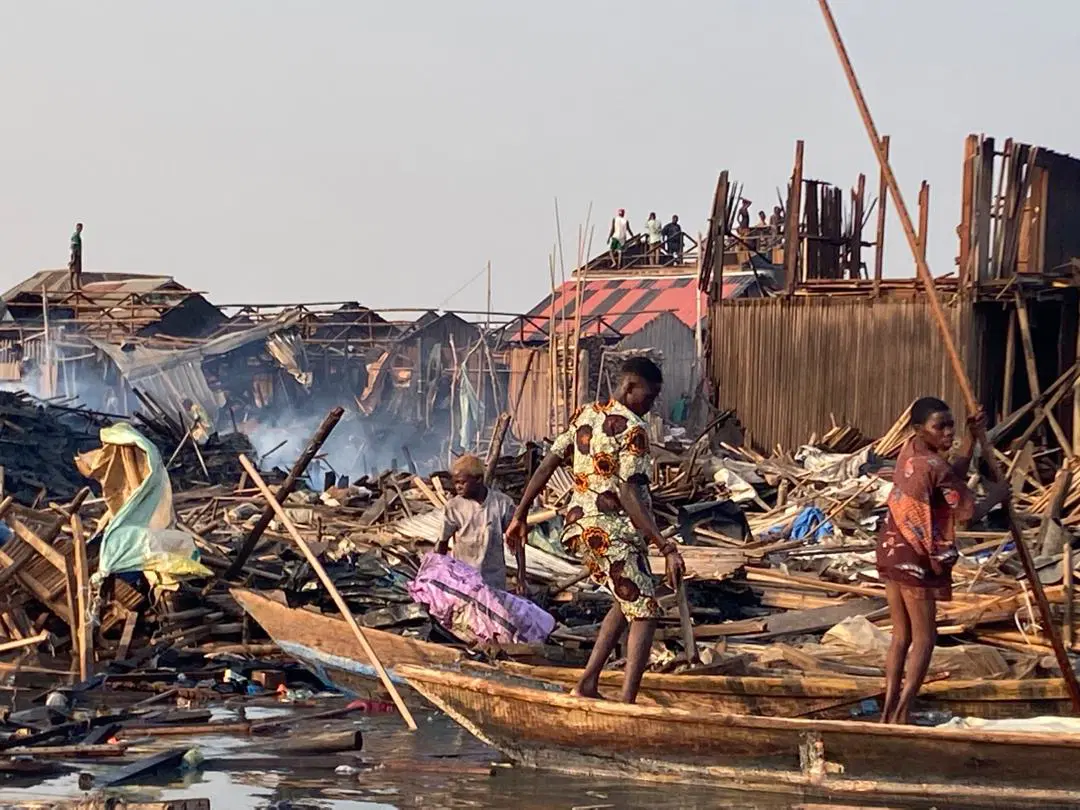
LAGOS: Relative calm has returned to Makoko in Lagos following weeks of tension and protests triggered by the recent demolition of parts of the waterfront settlement by the Lagos State Government.
The breakthrough comes after residents and government representatives signed a five-point agreement aimed at restoring peace and addressing lingering concerns.
The truce followed an on-the-spot assessment visit by an ad-hoc committee set up by the Speaker of the Lagos State House of Assembly, Mudashiru Obasa.
A subsequent stakeholders’ meeting involving the committee led by Noheem Adams, community leaders, and the Governor’s Special Adviser on e-GIS and Urban Renewal, Dr Babatunde Olajide, produced the agreement now endorsed by all parties.
According to Adams, the resolutions include a halt to further construction on demolished areas, the creation of a 10-member committee to discuss compensation for displaced residents, and the delineation of boundaries for the planned regeneration project. He also clarified that the government has no intention of eliminating the Makoko community.
Dr Olajide explained that the state plans to implement a Water City Project designed to improve sanitation, housing quality and environmental conditions in the settlement while preserving its fishing-based economy.
He noted that sanitation challenges remain severe in the area and require a coordinated regeneration effort.
Community leaders, including traditional heads, youth representatives and students, welcomed the dialogue but insisted on adequate compensation for those affected by the demolitions.
They also called for clearer plans on resettlement and accommodation, particularly for residents displaced from homes built on the waterfront.
Meanwhile, the Lagos State Government has defended the demolition exercise, describing it as a safety measure rather than an attempt to displace the community.
Officials argued that some structures were located beneath high-tension electricity lines and along critical waterways, posing significant safety risks.
Authorities maintain that the broader regeneration initiative estimated at about $10 million with support expected from development partners aims to upgrade Makoko rather than remove it. The proposed improvements include safer housing layouts, better sanitation systems, regulated waterways and environmental protection measures.
Despite government assurances, some residents remain cautious, citing fears over possible commercial redevelopment of waterfront land.
However, officials insist the Water City model is intended to balance urban development, public safety and preservation of the community’s cultural and economic identity.


