


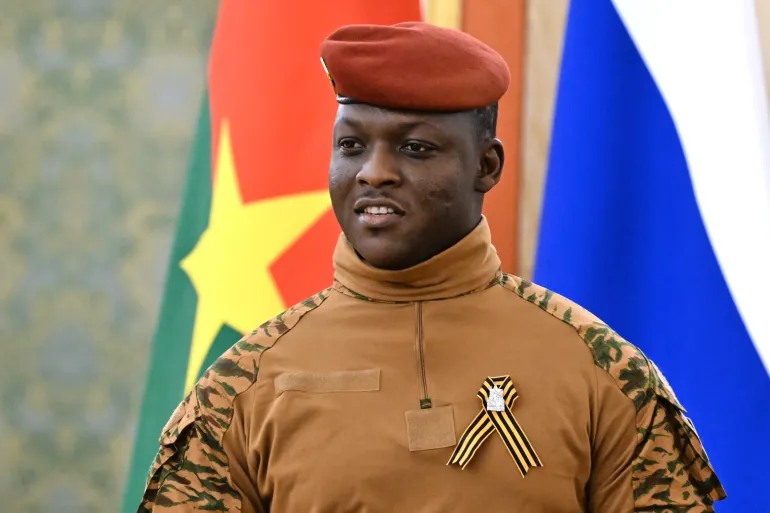
Burkina Faso’s military leader Ibrahim Traoré has stirred intense debate after declaring that citizens of the West African nation should “forget about democracy,” a statement that has drawn sharp reactions from political observers and civil society groups.
Speaking during a televised interview broadcast on state television, Traoré questioned the relevance of democratic governance in the current context of Burkina Faso, arguing that attempts to impose democratic systems in certain regions have often resulted in instability and violence.
People need to forget about the issue of democracy, Traoré said. We have to tell the truth Democracy isn’t for us.
He further described democracy as a system that can lead to conflict and suffering, pointing to the experience of Libya as an example of what he believes happens when democratic governance is introduced under external pressure.
Look at Libya, it’s a prime example right next to us. Everywhere they try to establish democracy in the world, it’s done with bloodshed, he said, adding that democracy is slavery.
Traoré seized power in September 2022 following a military coup that removed the democratically elected government of former president Roch Marc Christian Kaboré.
The coup came only eight months after an earlier military takeover in which Traoré also played a key role.
When the military government first assumed power, it promised to restore democratic rule and organise elections to return the country to civilian governance.
However, those plans have since been repeatedly delayed. Traoré initially pledged that elections would be held in 2024 but later said voting could not take place until the country regained full security and stability.
In January, the government took a dramatic step by dissolving more than 100 political parties across Burkina Faso, effectively ending organised political activity in the country.
Authorities also seized assets belonging to the dissolved parties, while parliament had earlier been suspended after the military takeover.
The government further tightened its grip on state institutions in July 2025 when it dissolved the national electoral commission, arguing that the body was too costly to maintain.
The decisions have sparked concern among opposition figures, journalists, and human rights advocates who warn that democratic institutions in the country are steadily being dismantled.
Reports have also emerged that critics of the military government including journalists, political activists, and prosecutors have been forcibly conscripted into military service and deployed to front-line positions in the fight against armed groups.
Some individuals were later released, but the incidents have raised alarms about press freedom and political repression.
Burkina Faso remains at the centre of a worsening security crisis in the Sahel region. Armed groups linked to al-Qaeda and Islamic State have carried out frequent attacks across the country, seizing large areas of territory and displacing hundreds of thousands of civilians.
Despite the military government’s pledge to prioritise security, violence has continued to escalate.
Analysts note that fatalities linked to the conflict have risen significantly since Traoré came to power. According to research by the Africa Center for Strategic Studies, deaths in the conflict tripled in the three years after the military takeover.
The report estimated that about 17,775 people were killed during that period, compared with 6,630 deaths recorded in the three years before the coup.
Burkina Faso’s military government has also shifted the country’s geopolitical alliances. Along with neighbouring Niger and Mali, the country withdrew from the Economic Community of West African States (ECOWAS) after disagreements over pressure from the regional bloc to restore democratic rule.
The three nations subsequently formed the Alliance of Sahel States; a new security and political alliance aimed at strengthening cooperation among the military-led governments.
At the same time, the countries have reduced their reliance on Western military support and turned instead to Russian paramilitary forces for assistance in combating armed groups.
This shift followed the expulsion of French troops from the region. France had previously deployed thousands of soldiers to the Sahel to help fight armed groups operating across the region.
Traoré’s comments about democracy are expected to intensify international debate about governance and political stability in the Sahel.
While the young military leader has gained popularity among some supporters—particularly within parts of the African diaspora for his strong anti-Western rhetoric—critics warn that dismantling democratic institutions could further isolate the country and complicate efforts to restore stability.
For now, Burkina Faso remains caught between a deepening security crisis and an uncertain political future as its military leadership charts a path increasingly distant from democratic governance.


