


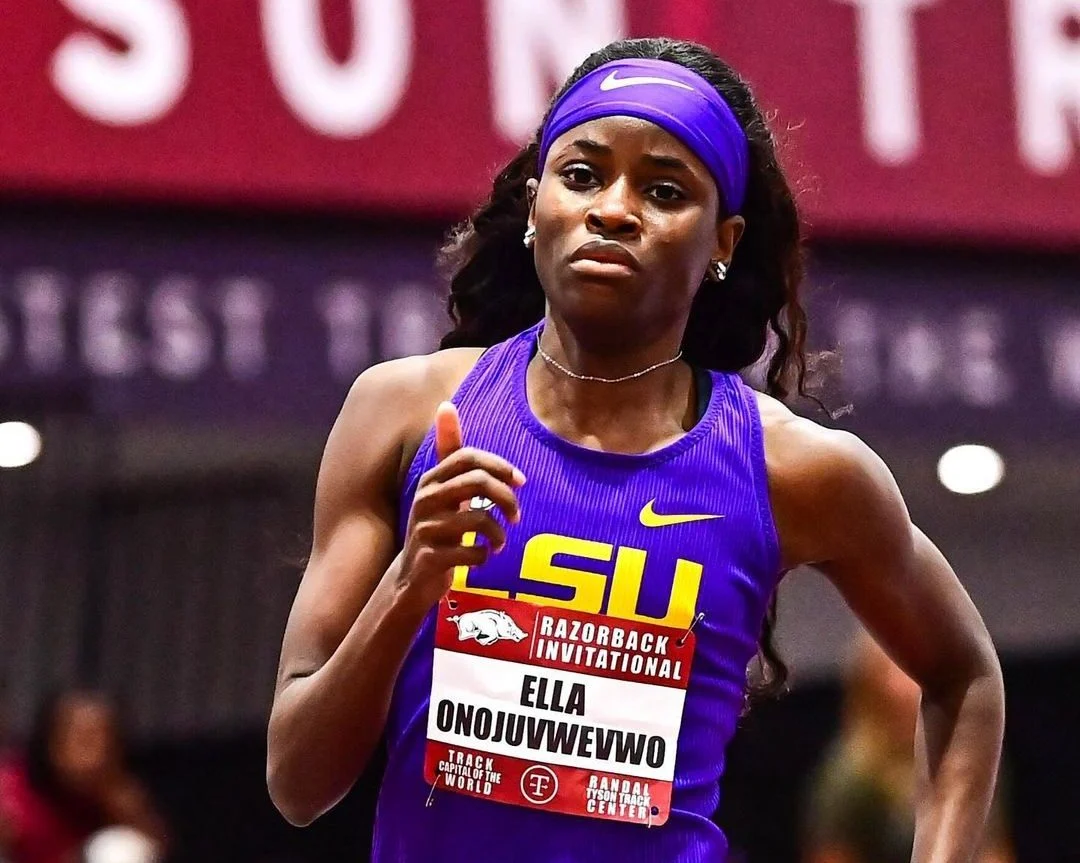
Nigerian athletes delivered remarkable performances across collegiate track events in the United States over the weekend, with Ella Onojuvwevwo setting a world-leading time in the women’s 400 metres while compatriot Blessing Ogundiran shattered a long-standing record in the 100 metres at the National Association of Intercollegiate Athletics level.
Onojuvwevwo produced a sensational run at the Battle on the Bayou meet in Louisiana, clocking an impressive 49.59 seconds in the women’s 400m. The performance not only secured victory for the Nigerian star but also established the fastest time recorded anywhere in the world in the event this season.
The blistering run further cemented Onojuvwevwo’s reputation as one of the most promising quarter-milers in global athletics and confirmed her dominance in the 2026 season.
Competing for LSU Tigers, the Nigerian athlete’s time also set a new school record and currently stands as the fastest mark in the National Collegiate Athletic Association season.
In addition to leading the global rankings for the year, her 49.59-second performance now ranks among the fastest times ever recorded in the history of the NCAA.
Athletics statisticians note that the time is the 10th-fastest performance in NCAA history, an achievement that places Onojuvwevwo among the elite runners ever to compete in the U.S. collegiate athletics system.
Her remarkable feat also carries special significance for Nigerian athletics. The time is the fastest recorded by a Nigerian female sprinter since the legendary Falilat Ogunkoya clocked 49.52 seconds in 1998.
Moreover, Onojuvwevwo’s performance marks the first time in more than two decades that a Nigerian woman has run under the 50-second barrier in the 400 metres.
The achievement places her seventh on the African all-time performance list and fourth among Nigeria’s fastest women ever in the event.
Observers say the result reflects both her rapid development and the increasing influence of Nigerian athletes within the U.S. collegiate athletics circuit.
Behind Onojuvwevwo in the race, Peace Nwaelehia of Texas A&M Aggies finished second with a time of 52.74 seconds, while Favour Onyah representing Southeastern Louisiana Lions placed third after crossing the line in 52.83 seconds.
Onojuvwevwo’s performance did not come as a surprise to athletics enthusiasts who had already witnessed her impressive form earlier in the season.
During the indoor campaign, the Nigerian athlete made headlines by breaking the African indoor 400m record at the NCAA Indoor Track and Field Championships.
At the competition held at the Randal Tyson Track Center in the United States, she clocked a time of 50.28 seconds, setting a new continental indoor record.
That run also stood as the fastest indoor performance globally at the time and established another school record for Louisiana State University.
The series of outstanding performances throughout the season has solidified her position as one of the most formidable female quarter-milers currently competing in the collegiate circuit.
While Onojuvwevwo dominated the 400 metres in Louisiana, another Nigerian sprinter was also making history in Florida.
At the Embry-Riddle Classic, Ogundiran produced a record-breaking performance in the women’s 100 metres at the National Association of Intercollegiate Athletics level.
The Nigerian athlete clocked a personal best of 11.21 seconds with a legal wind reading of +0.5 to break the NAIA women’s 100m record.
Her time surpassed the previous mark of 11.28 seconds set in 2014 by Jamaican sprinter Jura Levy.
The new record represents a major breakthrough for Ogundiran, who has steadily improved her performances since joining the U.S. collegiate system.
In addition to her record-breaking 100m performance, Ogundiran also produced another personal best in the women’s 200 metres during the preliminary rounds of the competition.
She clocked 23.59 seconds, marking her first officially recorded sub-24-second performance in the event.
The performance highlighted her versatility as a sprinter capable of competing strongly across both the short sprint and half-lap events.
Beyond the headline performances by Onojuvwevwo and Ogundiran, other Nigerian athletes also produced notable results at the Battle on the Bayou meet.
In the men’s long jump event, Charles Godfred finished in second place with a leap of 7.92 metres.
He narrowly missed first place after Jamaican jumper Jordan Turner recorded a winning distance of 7.95 metres.
Meanwhile, Nigerian hurdler Adaobi Tabugbo also delivered an encouraging performance at the Miramar Invitational.
She recorded a season-best time of 13.03 seconds in the women’s 100-metre hurdles to finish fourth in the race.
The series of impressive performances by Nigerian athletes across different competitions reflects the growing presence of the country’s track and field talents in the United States collegiate athletics system.
For decades, the NCAA and NAIA platforms have served as important development pathways for Nigerian athletes, providing access to world-class training facilities, elite coaching, and highly competitive racing environments.
Sports analysts say the recent achievements by athletes such as Onojuvwevwo and Ogundiran further demonstrate the depth of Nigeria’s sprinting talent.
Their performances have also strengthened hopes that Nigeria could once again produce world-class athletes capable of competing for medals at major international championships, including the Olympic Games and World Athletics Championships.
As the 2026 athletics season progresses, many observers will be watching closely to see whether Onojuvwevwo can maintain her impressive form and challenge some of the world’s best runners on the global stage.
For now, however, her world-leading time and Ogundiran’s record-breaking sprint stand as powerful reminders of the rising influence of Nigerian athletes in international track and field.