


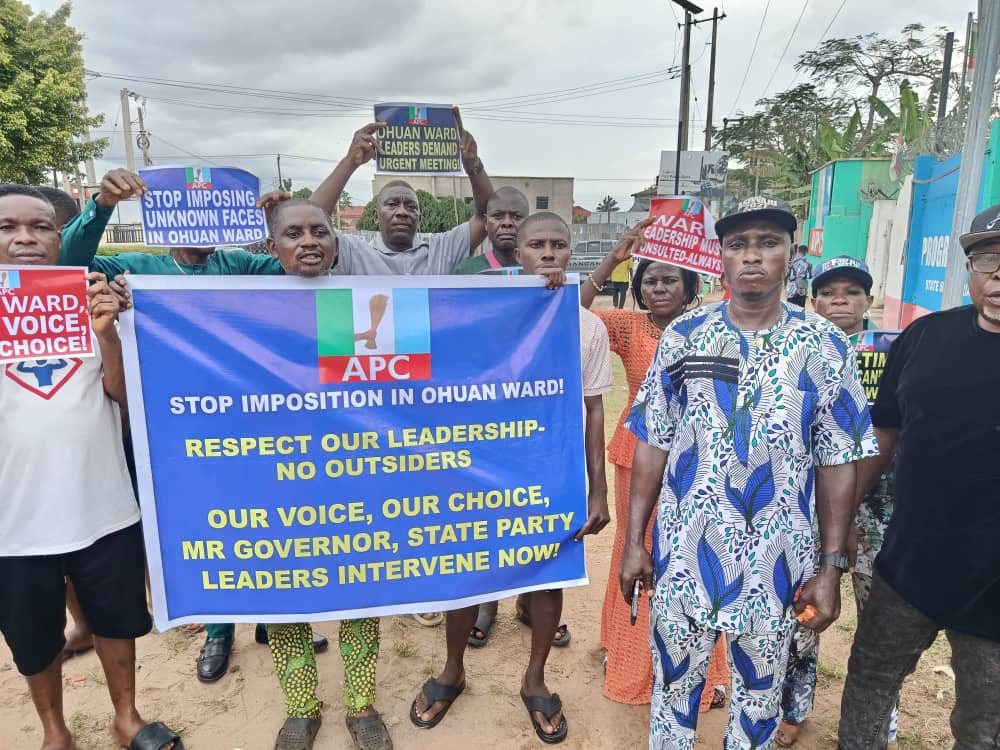
BENIN-CITY: Members of the All-Progressives Congress (APC) in Ohuan Ward 9, Uhunwonde Local Government Area, Edo State, have staged a protest at the party’s state secretariat over claims that a councillorship candidate was being imposed on them ahead of the forthcoming local government elections.
The incident has exposed growing tensions within the party and raised questions about internal democracy, transparency, and candidate selection processes in Edo State’s political landscape.
The protest was led by the ward’s consensus candidate, Mr. Sunday Erhabor, who accused unnamed individuals of attempting to replace his name with another despite his formal endorsement by the ward leadership.
According to the protesters, this development undermines the collective decision-making processes at the grassroots level, which had previously brought all aspirants and stakeholders together in agreement.
Addressing journalists during the demonstration, Erhabor emphasized that his emergence as the consensus candidate was the result of careful deliberation and unanimous approval by all five aspirants in the ward, alongside key party stakeholders.
The decision was reached on March 22 in the presence of all aspirants, who collectively resolved to support my candidacy, Erhabor said.
To learn that another candidate’s name has been submitted to the party secretariat without our knowledge is both surprising and deeply concerning. It contradicts the agreement we painstakingly reached.
He further reiterated that his loyalty to the APC remains steadfast but stressed that any reversal of his candidacy would only be acceptable if it was the result of a collective decision by the ward leadership and not through backdoor political maneuvering.
Protesters at the secretariat carried placards with inscriptions such as “Respect Ward Consensus, Uphold Due Process, and No Imposition, reflecting widespread dissatisfaction among grassroots members.
They warned that attempts to override local decisions could lead to disunity within the party at a time when cohesion is critical for electoral success.
Erhabor noted, “This is not a do-or-die situation. We are calling for fairness, transparency, and adherence to party rules. Internal democracy is a cornerstone of our party, and any action contrary to that principle could erode confidence in our leadership.
Political analysts observing the situation suggest that such disputes are not uncommon in Edo State politics, where local party structures wield significant influence over candidate selection.
They note that imposing candidates from outside consensus agreements often triggers protests, legal challenges, or even defections, potentially undermining party performance in elections.
An official of the APC addressed the aggrieved members, assuring them that the party leadership would investigate the matter thoroughly. He confirmed that a meeting of all stakeholders would be convened to resolve the dispute and stressed that the party is committed to upholding due process.
“The leadership of the APC is actively engaged to ensure that all decisions regarding candidacy are fair, transparent, and in accordance with party guidelines. Members are urged to remain calm while we address these concerns, the official said.
The party’s response underscores the delicate balance political parties must maintain between central leadership directives and grassroots expectations. It also highlights the critical role of ward-level democracy in preserving party unity and credibility ahead of competitive elections.
Observers note that the ongoing dispute in Uhunwonde LGA could have broader implications for the APC’s performance in local government elections across Edo State. Discontent at the ward level may spill over into other areas if not promptly resolved, potentially giving rival parties an advantage.
Moreover, this incident highlights a growing trend across Nigerian politics where internal party democracy is often tested by ambitions, competing interests, and the influence of powerful individuals.
Ensuring transparency in candidate selection is increasingly seen as essential to maintaining public confidence in political parties.
As Edo State prepares for its local government elections, the resolution of disputes such as the one in Uhuan Ward 9 will likely serve as a litmus test for the APC’s commitment to internal democracy.
Grassroots members, party observers, and political analysts will be closely watching how the leadership handles the situation, as it could set the tone for similar conflicts ahead of the 2027 general elections.
The ongoing protests serve as a reminder that political parties must constantly balance ambition, fairness, and transparency to sustain unity, prevent internal rifts, and retain the confidence of their members and the electorate.


