


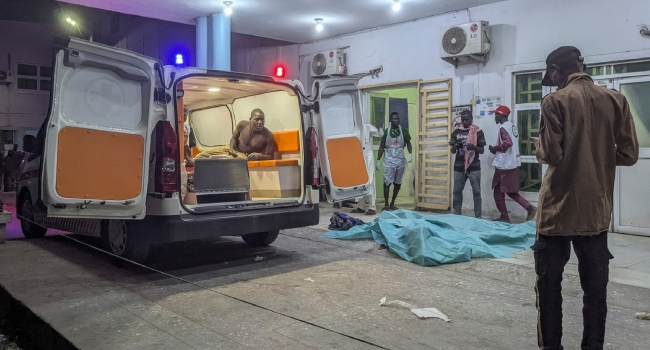
MAIDUGURI: At least 23 people have been confirmed dead while 108 others sustained varying degrees of injuries following multiple bomb explosions that rocked Maiduguri, the Borno State capital, on Monday night.
The Borno State Police Command disclosed the casualty figures on Tuesday, stating that the explosions were suspected to have been carried out by suicide bombers at three different locations within the city.
In a statement issued by the Command’s spokesperson, Nahum Kenneth-Daso, the blasts occurred at about 7:24 p.m. at the Maiduguri Monday Market, the gate of the University of Maiduguri Teaching Hospital (UMTH), and the Post Office Flyover area.
According to the police, preliminary investigations indicate that the explosions were triggered by suspected suicide bombers, resulting in heavy casualties.
Following the devastating suspected suicide Improvised Explosive Device (IED) explosions that occurred at about 1924 hours on March 16, 2026, at Maiduguri Monday Market, the University of Maiduguri Teaching Hospital gate, and the Post Office Flyover area, preliminary investigation reveals that the incidents were carried out by suspected suicide bombers,” the statement said.
Regrettably, a total of 23 persons lost their lives, while 108 others sustained varying degrees of injuries.
Security operatives, including police tactical teams, the military, and other joint security forces, were immediately deployed to the affected areas to restore order and prevent further attacks.
The affected locations were quickly secured and cordoned off while the Police Explosive Ordnance Disposal (EOD) Unit conducted a thorough sweep to ensure there were no additional explosive threats.
The Commissioner of Police in Borno State, Naziru Abdulmajid, also visited the blast sites to assess the situation and oversee the emergency response efforts.
During the visit, the police chief sympathized with victims and their families, assuring residents that security agencies remain committed to protecting lives and property.
Emergency responders from the National Emergency Management Agency (NEMA) and the Borno State Emergency Management Agency (SEMA) evacuated victims to nearby hospitals where the injured are currently receiving treatment.
Security presence has since been reinforced across Maiduguri and surrounding areas as authorities intensify surveillance to prevent further attacks.
The explosions have disrupted what had been a relatively peaceful period in Maiduguri over the past year. The city had experienced improved security as Nigeria’s long-running insurgency was largely pushed to rural areas of the northeast.
However, insurgent groups including Boko Haram and the Islamic State West Africa Province (ISWAP) have recently intensified attacks across the region.
The insurgency, which began more than 16 years ago, has claimed over 40,000 lives and displaced about two million people across northeastern Nigeria.
Reacting to the incident, Borno State Governor Babagana Zulum described the attacks as “barbaric,” linking the renewed violence to ongoing military operations against insurgents in the Sambisa Forest, a known stronghold of extremist fighters.
Maiduguri, which once experienced frequent bombings and shootings during the peak of the insurgency in the mid-2010s, had enjoyed relative calm in recent years.
The last major attack in the city occurred in 2021 when insurgents fired mortars into Maiduguri, killing 10 people.
However, sporadic attacks have continued in recent months. In December, a suspected suicide bomber attacked a mosque in the city, killing at least seven people.
Violence has also persisted in communities surrounding Maiduguri. Just last week, the Nigerian Army confirmed coordinated attacks on several military bases in the northeast, which reportedly left at least 14 people dead, including 10 soldiers.
Meanwhile, the United States recently announced the deployment of about 200 troops to Nigeria to provide technical and training support to Nigerian forces fighting jihadist groups in the region.
Despite ongoing security efforts, authorities say both Christians and Muslims remain victims of the insurgency, which continues to pose a major security challenge in the country’s northeast.