


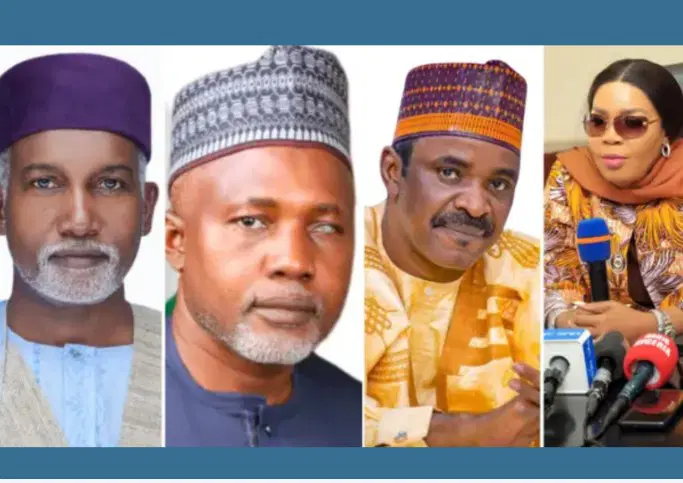
The political landscape ahead of Nigeria’s 2027 general elections is becoming increasingly intense following the resignation of several cabinet members and top government officials in the administration of Bola Ahmed Tinubu who have declared their intention to contest various elective offices.
Their decision to step down from the Federal Executive Council has significantly altered political permutations across several states, setting the stage for potentially fierce contests for governorship and National Assembly seats.
The affected states include Kano State, Abia State, Bauchi State, Gombe State, Kebbi State and Adamawa State, where political realignments and rivalries are already reshaping the race for power.
Analysts say the development could trigger intense competition within political parties, particularly the ruling All Progressives Congress, as well as among opposition groups preparing to challenge the ruling party in key battleground states.
Among the ministers who resigned to pursue political ambitions is Nkeiruka Onyejeocha, the former Minister of Labour and Employment, who is seeking a return to the House of Representatives from the Isuikwuato–Umunneochi Federal Constituency in Abia State.
Also leaving the cabinet is Sa’idu Ahmed Alkali, former Minister of Transportation, who has set his sights on the governorship of Gombe State.
Similarly, Yusuf Maitama Tuggar resigned from his position as Minister of Foreign Affairs to pursue the governorship seat in Bauchi State.
Another minister who exited the federal cabinet is Yusuf Tanko Sununu, the former Minister of State for Humanitarian Affairs and Poverty Reduction, who is eyeing a return to the House of Representatives from Kebbi State.
Their resignations reportedly followed a directive from President Tinubu requiring political appointees interested in contesting elections to step down from their positions ahead of the campaign season.
Beyond the cabinet members, several senior officials in federal agencies have also resigned to pursue electoral ambitions.
Among them is Abdulrazak Namdas, who stepped down as a board member of the Niger Delta Development Commission to contest the governorship election in Adamawa State.
Also joining the Adamawa governorship race is Ahmed Aminu, who resigned as Executive Secretary of the Petroleum Technology Development Fund.
In Kano State, former deputy governor Nasiru Yusuf Gawuna resigned as chairman of the governing board of the Federal Mortgage Bank of Nigeria to contest the governorship election under the platform of the African Democratic Congress.
Similarly, in Oyo State, former deputy governor Rauf Olaniyan resigned as chairman of the governing council of the Federal College of Education (Technical) to pursue the governorship ticket of the APC.
In Bauchi State, the entry of former Foreign Affairs Minister Yusuf Tuggar into the governorship race has significantly heightened political tension within the APC.
Several aspirants had already indicated interest in the position before Tuggar joined the contest, including oil industry executive Bala Wunti and Senator Umar Shehu Buba.
In addition, the 2023 APC governorship candidate, Sadiq Abubakar, has reportedly moved to the African Democratic Congress to pursue his political ambition.
Another contender, Senator Dauda Haliru Jika, is said to be considering running under the New Nigeria Peoples Party.
The growing list of aspirants has created uncertainty around the political future of the state, especially for the incumbent governor, Bala Mohammed.
Political observers say the governor is still weighing his political options amid reported disagreements within the Peoples Democratic Party.
Reports suggest that Mohammed may consider aligning with another political platform as he prepares for his next political move.
In Gombe State, Sa’idu Alkali’s entry into the governorship race may complicate the succession plans of the incumbent governor, Muhammadu Inuwa Yahaya.
The governor is believed to be considering several loyalists as potential successors, including the state Accountant-General Aminu Umar Yuguda, Commissioner for Finance Muhammad Magaji, and businessman Yunusa Yakubu.
However, the entry of a former minister into the race could reshape the internal dynamics within the APC and influence the final choice of candidate.
Meanwhile, in Kano State, the governorship contest is already drawing significant attention following the decision of Nasiru Gawuna to run under the ADC platform.
His move poses a potential challenge to the current governor, Abba Kabir Yusuf, whose political fortunes remain closely linked to the influence of his mentor, Rabiu Musa Kwankwaso.
Analysts say the political landscape in Kano remains fluid, especially following recent political realignments that have reshaped alliances within the state.
In Abia State, Nkeiruka Onyejeocha’s decision to return to the National Assembly race has raised political tension in the Isuikwuato–Umunneochi Federal Constituency.
She will face a strong challenge from the incumbent lawmaker, Amobi Ogah, who represents the constituency under the Labour Party.
Onyejeocha, a former deputy chief whip of the House of Representatives, served in the National Assembly for 16 years before losing the seat in the 2023 elections.
Her supporters believe her extensive legislative experience and grassroots networks could boost her chances in the upcoming contest.
However, political observers say the incumbent lawmaker has strengthened his support base through empowerment programmes and constituency development projects.
In Adamawa State, the governorship race is also shaping up to be highly competitive.
Both Abdulrazak Namdas and Ahmed Aminu are expected to seek the support of the outgoing governor, Ahmadu Umaru Fintiri.
Political analysts say the governor’s influence could play a decisive role in determining who eventually emerges as the party’s candidate.
With multiple aspirants entering the race across different states, the early political manoeuvring suggests that the road to the 2027 elections may be marked by intense rivalry, shifting alliances and strategic negotiations among Nigeria’s political elite.
As parties prepare for primaries and campaign strategies begin to take shape, the coming months are expected to reveal how these emerging battles will reshape Nigeria’s political landscape ahead of the next general elections.


