


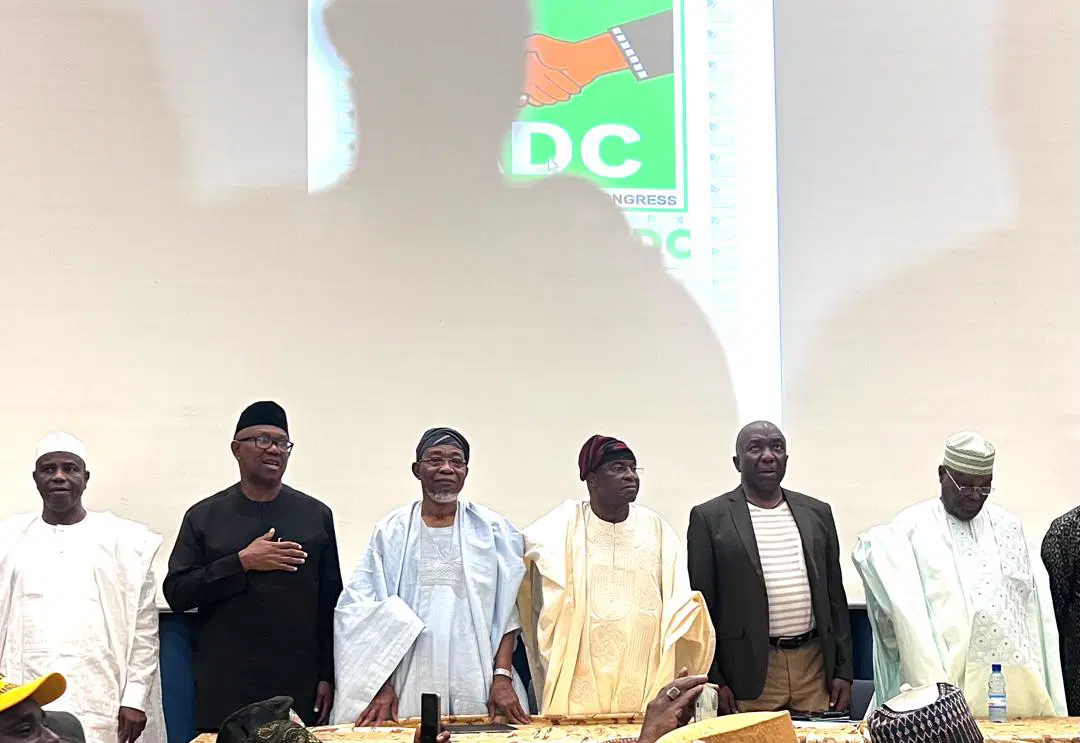
The African Democratic Congress (ADC) has accused the Independent National Electoral Commission (INEC) of deliberately creating administrative hurdles aimed at preventing the party from fielding candidates in the 2027 general elections.
The allegation came as the electoral commission remained silent over a 72-hour ultimatum issued by ADC youths demanding the reversal of INEC’s decision not to recognize the party’s National Executive Committee led by David Mark.
At the same time, the camp of former Peter Obi, the 2023 presidential candidate of the Labour Party, alleged a coordinated political effort by the ruling All Progressives Congress (APC) to block Obi from appearing on the ballot in 2027.
However, the APC quickly dismissed the allegation, insisting the ruling party has no role in Obi’s political challenges.
In a statement issued by its National Publicity Secretary, Bolaji Abdullahi, the ADC said INEC had taken steps that could effectively prevent the party from participating fully in the next general elections.
According to the party, INEC recently informed ADC that it would no longer receive any official correspondence from the party pending the outcome of an ongoing case before the Federal High Court.
While the decision may appear procedural, ADC argued that it directly conflicts with timelines established in the Electoral Act 2026, which require political parties to meet strict deadlines for internal processes such as submitting candidate lists.
The party warned that INEC’s stance could make it impossible for the ADC to comply with these statutory deadlines.
The statement said the commission had earlier recognised the leadership that emerged from the party’s National Executive Committee meeting of July 29, 2025, which INEC officials monitored.
ADC claimed INEC had subsequently updated its records to reflect the new leadership structure, including the appointment of David Mark as National Chairman and Rauf Aregbesola as National Secretary.
According to the party, the commission’s refusal to accept communications now contradicts its earlier actions and creates a pathway that could lead to the exclusion of the party from the electoral process.
In simple terms, unless the courts deliver judgment before the deadline for submissions, INEC’s position could prevent the ADC from producing candidates, the party said.
Meanwhile, the media office of Peter Obi alleged that the crisis surrounding the ADC and the Labour Party is part of a broader strategy to prevent Obi from contesting the 2027 presidential election.
In a statement signed by spokesman Ibrahim Umar, the office claimed the political manoeuvres began shortly after the 2023 elections.
The statement alleged that internal crises within the Labour Party were deliberately engineered to weaken Obi politically.
It further argued that recent amendments to electoral laws and INEC’s actions regarding ADC leadership were aimed at undermining Obi’s presidential ambitions, particularly after his reported alignment with an ADC coalition.
The statement warned that such developments could create the appearance of democratic competition while effectively pushing Nigeria toward a one-party political system.
Reacting to the allegations, Nentawe Yilwatda, the National Chairman of the APC, through his Special Adviser on Media and Communication Strategy, Abimbola Tooki, rejected claims that the ruling party was interfering in opposition politics.
Tooki said Obi and his associates should resolve their party’s internal issues rather than blaming the APC.
INEC has guidelines that apply to all political parties. The APC is operating under the same rules, he said.
He added that recurring crises within opposition parties were not the responsibility of the ruling party.
The crisis deepened as the ADC youth wing issued a 72-hour ultimatum to INEC to reverse its decision and restore the David Mark-led leadership on its official portal.
Speaking in Abuja, the party’s National Youth Leader Balarabe Rufai accused the electoral commission of interfering in the internal affairs of the party.
He warned that failure to comply would trigger nationwide protests across the 36 states and the Federal Capital Territory.
Rufai argued that INEC had earlier recognised the outcome of the party’s NEC meeting before reversing its position without clear justification.
According to him, the commission lacks the constitutional authority to interpret court orders relating to party leadership disputes.
“We will initiate nationwide, peaceful and lawful civic actions across the country if this injustice is not reversed, he said.
The development has also attracted criticism from civil society organisations.
The Executive Director of the Civil Society Legislative Advocacy Centre, Auwal Rafsanjani, warned that INEC’s handling of the matter could trigger a wider democratic crisis.
Rafsanjani said excluding political parties from participating in elections would undermine Nigeria’s multi-party democracy and damage public confidence in the electoral process.
He urged the electoral commission to act transparently and ensure a level playing field for all political parties.
Political parties must be allowed to participate freely so citizens can choose candidates that represent their aspirations, he said.
With opposition parties raising alarms and youth groups threatening protests, analysts warn that the dispute could further heat up Nigeria’s political landscape ahead of the 2027 elections.
Observers say the situation highlights the growing tension within the country’s political system, where legal battles, party leadership crises and electoral disputes are increasingly shaping the contest for power.