

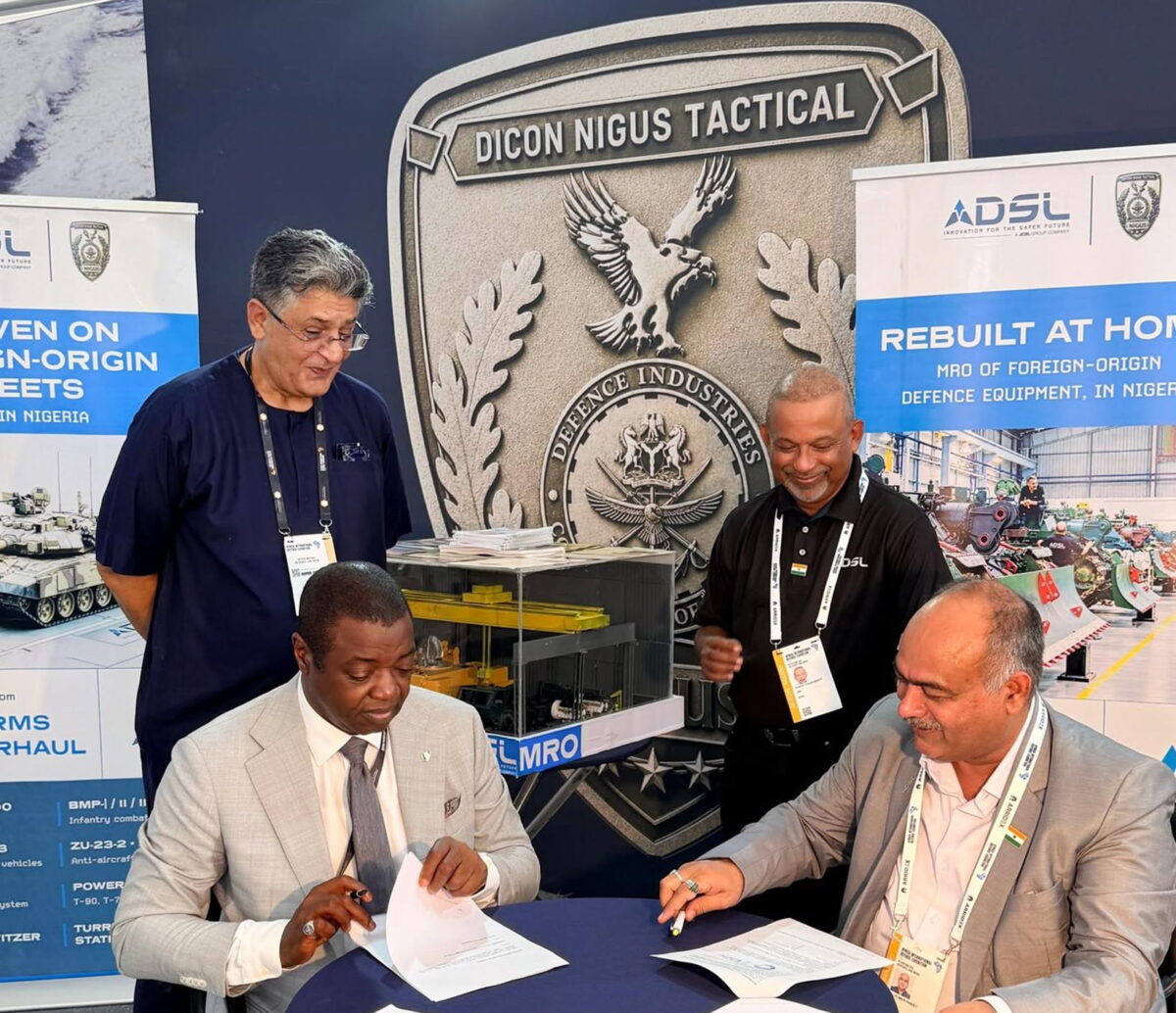
Nigeria has taken another step towards strengthening its indigenous defence industry following a partnership between Nigus Hercules Limited and India’s Airbornics Defence & Space Private Limited (ADSL) to develop local maintenance, repair and overhaul (MRO) capabilities for military equipment.
The partnership is expected to improve Nigeria’s ability to maintain, repair and modernise equipment used by the Nigerian Armed Forces, while reducing dependence on foreign facilities for specialised defence support services.
ADSL, the defence and aerospace division of India’s JCBL Group, said the collaboration would combine its engineering expertise with Nigerian industrial participation to build sustainable defence equipment maintenance infrastructure within the country.
The agreement follows ADSL’s participation in the inaugural Africa International Defence Exhibition (AFRIDEX) 2026, held in Lagos, where the Indian company showcased its defence technologies and explored opportunities for industrial cooperation across Africa.
According to the company, its Nigerian engagement goes beyond supplying military products to developing the technical expertise and infrastructure needed to sustain and modernise defence platforms locally.
Under the proposed programme, the MRO initiative will cover armoured vehicles, engines and air defence equipment used by the Nigerian Armed Forces.
ADSL is expected to provide engineering expertise, specialised overhaul processes, technical training and spare-parts support as part of the arrangement.
The initiative is designed to improve equipment availability, shorten repair turnaround times and develop the technical skills of Nigerian engineers and defence industry personnel.
The partners also envisage establishing a Centre of Excellence in Nigeria dedicated to lifecycle support, upgrades and the extension of the operational lifespan of armoured military platforms.
The proposed facility is expected to support technology transfer, create local employment opportunities and strengthen Nigeria’s capacity to maintain critical defence equipment.
Implementation will be carried out in phases, depending on agreed service requirements, facility readiness and the progress of technical training.
Prince Malik Ado-Ibrahim, Chief Executive Officer of Nigus Hercules Limited, said the partnership represented a practical move towards building Nigeria’s ability to independently sustain the military equipment used by its armed forces.
He stressed the importance of developing local skills, dependable technical support and long-term industrial capacity under the framework of the Defence Industries Corporation of Nigeria (DICON).
“Nigeria must build the capacity to maintain and sustain the equipment its Armed Forces depend on. Through Nigus Hercules, Nigus Tactical and our partnership with ADSL, we are taking a practical step towards that goal. Our focus is Nigerian skills, dependable local support and lasting industrial capability under the DICON framework,” Ado-Ibrahim said.
Rohit Nandal, Chief Operating Officer of Nigus Hercules Limited, also described the development of world-class MRO capabilities as essential to Nigeria’s defence self-reliance.
He said the partnership would promote knowledge transfer, strengthen local engineering expertise and help ensure that military equipment remains operational and ready for deployment.
Nigus Tactical Systems Limited, the Nigerian partner within Nigus Hercules Limited, is developing indigenous defence industrial capacity through the DICON Nigus Tactical platform under the DICON Act framework.
The new MRO programme is expected to complement these efforts by establishing the technical infrastructure required to support military equipment throughout its operational lifecycle.
ADSL said the agreement reflects its strategy of working with local partners to adapt established technologies to the requirements of individual markets while developing indigenous industrial capabilities.
Raj Kumar Pandey, Joint Managing Director of ADSL and JCBL Group, emphasised the importance of joint development with customers and local partners.
“It is better to have a joint development along with the customer,” Pandey said.
He explained that the company had previously adapted technologies to meet the requirements of the Indian market and intended to apply a similar approach to its engagement with African countries.
Sandip Chakroborty, Joint Managing Director (Operations) of ADSL and JCBL Group, said the partnership would combine international technology standards with Nigerian industrial capabilities.
He said the planned Centre of Excellence would provide lifecycle support, upgrades and life-extension services for armoured platforms while creating local jobs and developing specialised technical expertise.
ADSL also indicated that its Nigerian operations could eventually support defence maintenance requirements across the Economic Community of West African States (ECOWAS) region.
ADSL brings experience in maintaining, refurbishing and modernising military platforms, including T-72 tanks and BMP infantry fighting vehicles.
In India, the company has signed an agreement with the Indian Army’s Fire and Fury Corps to establish a New Generation Vehicle (NGV) Repair Hub and Warehouse at the 14 Corps Zonal Workshop in Leh.
Its international industrial partnerships also include cooperation with Slovakia on the co-development of turrets, active protection systems and remote-controlled weapon systems for light tanks, with manufacturing based in India.
These experiences are expected to contribute to the technical expertise ADSL will bring to the Nigerian partnership.
At AFRIDEX 2026, organised by dmg events and hosted by the Defence Industries Corporation of Nigeria under the patronage of the Federal Republic of Nigeria, ADSL showcased a range of defence and aerospace technologies.
Its exhibition portfolio included counter-unmanned aerial systems, protected mobility vehicles, weapon stations, active protection systems, radar and aerial delivery equipment.
Among the products displayed were the Tusker Counter-UAS System, ADSL Tusker Light Bulletproof Vehicle and CANNA-50 Remote-Controlled Weapon Station.
The company also presented its Active Protection System, Turret System, radio-frequency detector and jammer, radar, 50-tonne trailer, Platform Plus Parachute System for aerial drops and Military Combat Parachute System.
The partnership with Nigus Hercules represents an effort to translate such defence technology engagement into local industrial development.
The proposed MRO arrangement comes amid growing efforts to strengthen Nigeria’s domestic defence manufacturing and maintenance capacity.
Developing local facilities for repairing and upgrading military equipment could help reduce the time required to return damaged or poorly maintained platforms to operational service.
It could also create opportunities for Nigerian engineers, technicians and other skilled personnel to acquire specialised knowledge through technology transfer and practical training.
However, the actual impact of the initiative will depend on the implementation of the agreement, the establishment of the proposed facilities, the availability of technical resources and the extent of local participation.
For Nigeria, the partnership offers an opportunity to move beyond the procurement of military equipment towards building the domestic industrial capacity required to maintain, upgrade and sustain such assets over the long term.