
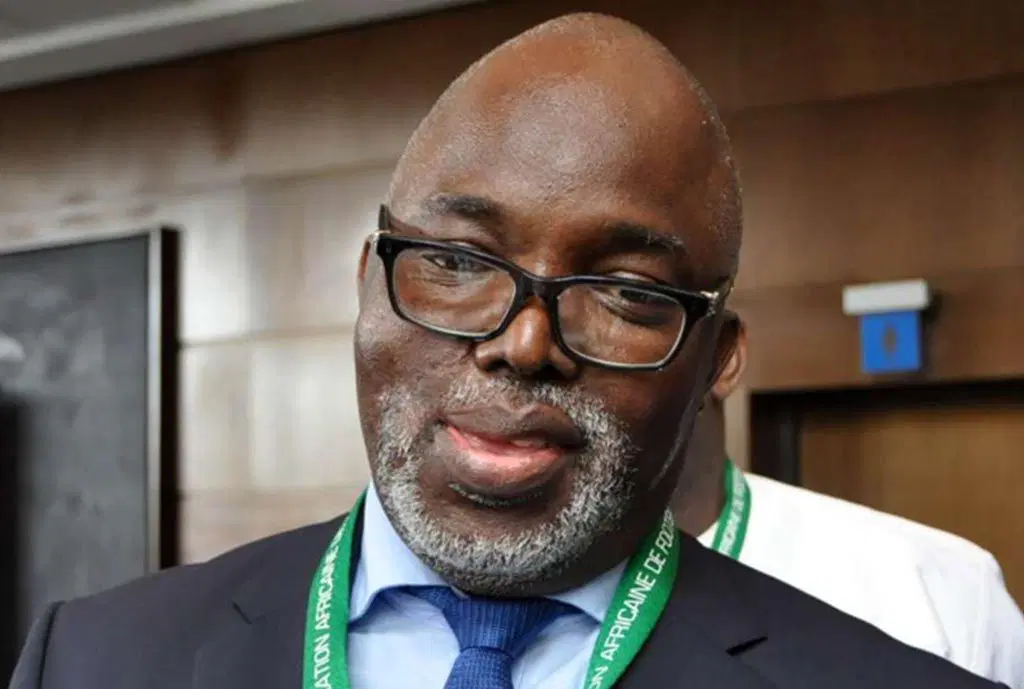
Former Nigeria Football Federation president Amaju Pinnick has revealed how Nigeria lost sponsorship relationships with global sportswear giants Adidas and Puma, blaming some Nigerians for actions that damaged the country’s image and affected negotiations.
Pinnick made the disclosure during an interview with former Super Eagles coach Sunday Oliseh on The Pinnick Tapes (Remastered): NFF Scandals EXposed, a YouTube programme.
According to the former NFF president, Adidas had already indicated its intention to terminate its relationship with the federation shortly after he assumed office.
Pinnick said he was shocked when he received the company’s letter announcing its decision to leave.
“I was utterly flabbergasted when I got the letter from Adidas. A few weeks or a few months into my being NFF president, they were leaving,” he recalled.
He said he subsequently travelled to Zurich to meet Adidas’ president in an attempt to persuade the company to reconsider its decision.
However, his efforts failed.
Pinnick said he later discovered that several issues had influenced Adidas’ decision, although he declined to publicly disclose details because, according to him, doing so could implicate individuals.
It was later I found out so many things that are, you know, that I cannot come out in the media to say. I don’t like indicting people,” he said.
Pinnick said Adidas was not the only major corporate partner that was withdrawing from Nigerian football around the period.
He listed Globacom, General Insurance and Guinness among companies that had either left or indicated that they were preparing to end their relationships with the federation.
“When we came on, Globacom was leaving, Adidas had left, General Insurance had left, Guinness—they wrote us that they were leaving,” Pinnick said.
The former NFF boss said he then turned his attention to Puma in an effort to secure another major sportswear partnership for the Super Eagles.
However, he encountered another setback during the 2015 Africa Cup of Nations in Equatorial Guinea.
Pinnick recalled meeting the head of Puma and said the executive initially appeared unwilling to engage with him after discovering that he was Nigerian.
I was introduced to the head of Puma. The head of Puma meant he understood that I was a Nigerian, not even as president of anything at that point. He didn’t want to talk to me,” he said.
Pinnick said the Puma executive subsequently explained that he had developed a negative perception of Nigeria following an alleged incident involving three Nigerians who visited his home on Christmas Day.
According to Pinnick, the men allegedly told the executive that they could abandon an existing Adidas contract but attached certain demands to the proposal.
He told me a story about how three Nigerians came to his house on a Christmas Day to tell him, ‘We can jettison the contract we have with Adidas, but this is what we wanted,’” Pinnick recalled.
Pinnick said the incident reportedly convinced the Puma executive never to do business with Nigeria.
And from there on, he made up his mind never ever to have anything to do with Nigeria. He blacklisted Nigeria,” he quoted the executive as saying.
Pinnick did not identify the three Nigerians involved or disclose the demands they allegedly made.
Despite losing Adidas and failing to secure Puma, Pinnick said the setbacks strengthened his determination to find another leading international sportswear company for the Super Eagles.
“But that was when I made up my mind that Adidas gone, Puma gone, we will definitely get the best,he said.
He recalled travelling to the United States and the Netherlands as part of efforts to negotiate a new kit sponsorship agreement.
The negotiations eventually resulted in a deal with Nike.
And that’s where I went to my room and I prayed and I said, ‘God, give us Nike.’”
It was a tough call, but eventually we got Nike,” Pinnick said.
Pinnick also rejected suggestions that his administration was responsible for declining sponsorship fortunes at the NFF.
He maintained that his tenure actually brought additional sponsors and improved the federation’s level of self-funding.
When I was president of NFF, no sponsors left me. I brought in sponsors. I went from zero to almost 80% of self-funding, he said.
He added that the figures could be verified through the NFF’s audited accounts prepared by PricewaterhouseCoopers.
Pinnick’s comments came during a wider discussion with Oliseh about challenges confronting Nigerian football, including the Super Eagles’ failure to qualify for the 2022 and 2026 FIFA World Cups, unpaid salaries involving coaches and players, political interference and other structural problems affecting the sport.