


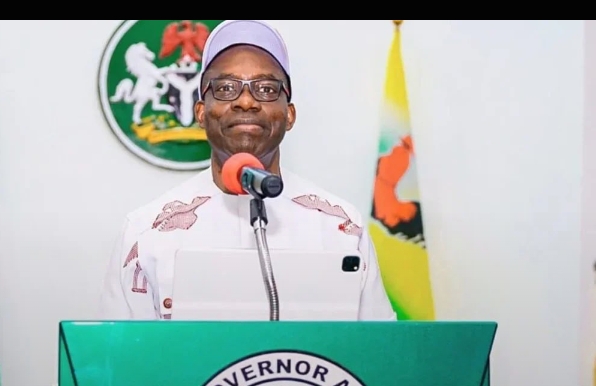
ANAMBRA: Anambra State Governor, Professor Chukwuma Charles Soludo, has suggested that political support for President Bola Ahmed Tinubu by the South-East could help pave the way for a future Igbo presidency, expressing optimism that the South-West would reciprocate when presidential power returns to the South after another turn in the North.
Soludo’s position underscores the importance of political cooperation, regional alliances and mutual understanding among Nigeria’s geopolitical zones in the struggle for power and national leadership.
The governor’s statement presents support for Tinubu as a potential opportunity for the South-East to strengthen its political relationship with the South-West and build goodwill ahead of future presidential contests.
According to the statement, if the South-East supports Tinubu, the South-West would support an Igbo presidency when power returns to the South after moving to the North.
The proposition places the question of an Igbo president within the broader debate over Nigeria’s power rotation arrangement, regional representation and the search for an inclusive political settlement.
The South-East has continued to feature prominently in conversations about equitable representation and access to the nation’s highest political office. Calls for an Igbo presidency have often centred on national unity, fairness and the argument that the region should have an opportunity to produce Nigeria’s president.
Soludo’s reported remarks suggest that political support for the incumbent administration could form part of a longer-term strategy to build alliances beyond the South-East.
However, political support for Tinubu does not automatically translate into a binding agreement on a future Igbo presidency. Any such outcome would depend on negotiations among political parties, regional leaders, presidential aspirants and voters.
The debate also comes against the backdrop of Nigeria’s evolving political calculations ahead of the 2027 general elections and beyond.
Although power rotation has remained an important consideration in Nigerian politics, it is not a constitutional guarantee that presidential power must alternate between the North and the South or that a particular region will produce the next president.
The country’s presidential elections are ultimately determined by constitutional requirements, party nominations and votes cast by Nigerians across the federation.
For the South-East, the challenge will be to translate regional aspirations into broader national political partnerships capable of attracting support across the country.
Soludo’s position raises a wider question about whether cross-regional political alliances can offer a credible pathway towards an Igbo presidency.
While cooperation between the South-East and South-West could strengthen political relationships, the durability of such an arrangement would depend on trust, clearly communicated commitments and the willingness of political stakeholders to sustain the partnership.
For now, the governor’s reported remarks add another dimension to the national conversation about regional unity, presidential succession and the future of Nigeria’s political power-sharing arrangements.


