


Suspected terrorists operating in parts of northern Nigeria are dispersing and relocating following recent airstrikes carried out by the United States military, community leaders and security sources have confirmed.
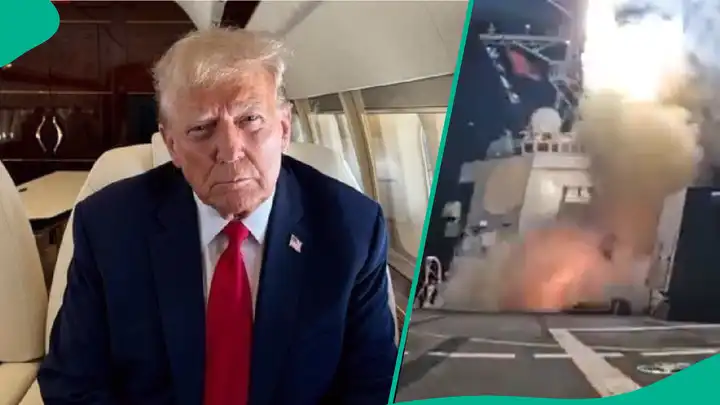
The missile strikes, conducted on Christmas night, targeted locations believed to be hideouts of Islamic State-linked fighters in northwestern Nigeria.
US President Donald Trump announced the operation, describing it as a decisive action against terrorist elements threatening lives and stability in the region. The Federal Government later confirmed that the strikes were executed with Nigeria’s support.
Although no fatalities were officially recorded at the strike locations, the operation has reportedly disrupted terrorist operations and forced armed groups to abandon established camps.
In Sokoto State, a missile reportedly landed on farmland in Jabo, Tambuwal Local Government Area, while buildings were damaged in Offa, Kwara State. Additional strikes were also reported around Tangaza axis, targeting suspected Lakurawa group hideouts.
Residents in parts of Sokoto said the aftermath of the strikes has been marked by unusual movements, with armed groups seen travelling in smaller units through forest corridors and border communities in an apparent attempt to evade surveillance.
A traditional ruler in Gwer West Local Government Area of Benue State, Daniel Abomtse, raised concerns over an influx of armed herders into his domain, which he linked to the recent airstrikes.
According to him, fleeing bandits have been moving from the northwest towards parts of Benue and Agatu with sophisticated weapons.
“They are running away from Sokoto towards coastal and middle-belt areas and are now grazing openly with arms, he said, calling on the US to extend similar operations to other affected states including Benue, Kogi, Taraba, Niger and Plateau.
Efforts to obtain official confirmation from the Benue State Police Command were unsuccessful as of the time of filing this report.
In Sokoto, community leaders in Tangaza, Gudu and Illela confirmed that the strikes had created confusion among terrorist groups, forcing them to abandon familiar routes and camps.
Security officials said intelligence assessments were ongoing to determine the scale and direction of the movements, while border patrols and joint security operations have been intensified to block escape routes.
Security experts say the displacement could lead to new risks if fleeing fighters attempt to blend into civilian populations. Kabiru Adamu, a security analyst and CEO of Beacon Consulting, warned that the groups may also turn to propaganda and seek international support to rebuild their networks.
“The terrorists will likely attempt to integrate into law-abiding communities, push propaganda narratives and seek external funding or alliances,” Adamu said, urging Nigerian security agencies to enhance surveillance and intelligence coordination.
Meanwhile, the United States has reportedly resumed intelligence, surveillance and reconnaissance operations over the Sambisa Forest in Borno State.
A Sahel-focused terrorism tracker disclosed that a Gulfstream V aircraft, commonly used for ISR missions, was observed conducting operations over the area, indicating renewed monitoring of ISWAP activities.
A professor of Defence Studies at the Nigerian Defence Academy, Tar Usman, said the US intervention could temporarily disrupt terrorist planning and instil fear among armed groups, though he cautioned that it would not automatically end insurgency.
“The uncertainty of future strikes will distract them, but vigilance remains critical because these groups may adapt and change tactics,” he said.
A senior government source disclosed that Nigeria and the United States are working closely to prevent the spread of terrorism, banditry and kidnapping, adding that measures were being taken to track and flush out fleeing fighters across neighbouring states.