


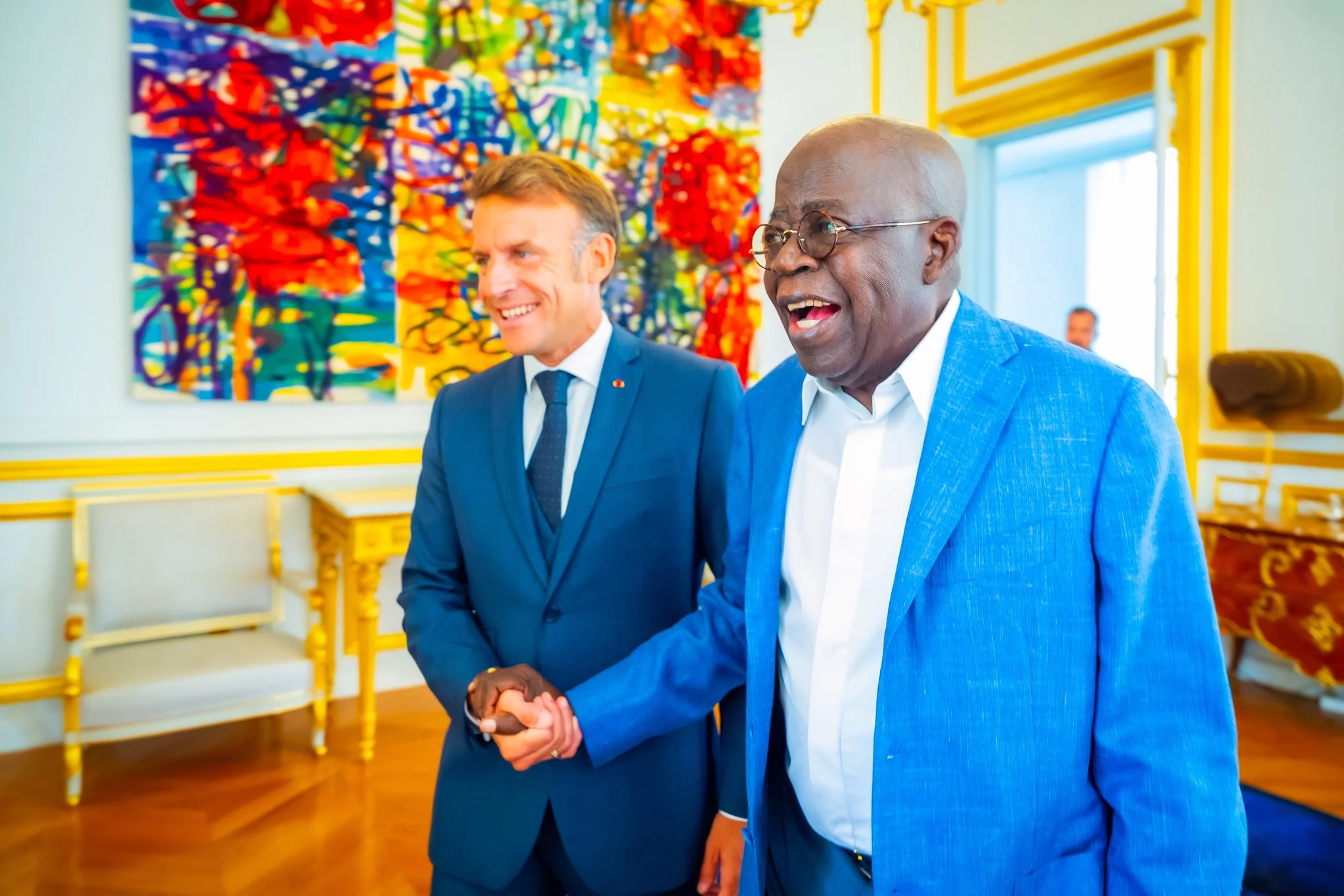
ABUJA: President Bola Tinubu on Sunday held talks with French President Emmanuel Macron on Nigeria’s worsening security challenges, as a United States fact-finding delegation arrived in Abuja for high-level engagements with Nigerian security officials.
Macron disclosed the telephone conversation in a message posted on X, stating that France would strengthen cooperation with Nigerian authorities, particularly in response to terrorism in the North.
I spoke with President Tinubu of Nigeria. I conveyed France’s solidarity in the face of the various security challenges, particularly the terrorist threat in the North,” Macron wrote.
At his request, we will strengthen our partnership with the authorities and our support for the affected populations. No one can remain a spectator.”
The discussions came amid escalating gun attacks and kidnappings across northern communities, drawing increased international concern. Macron’s message followed Tinubu’s recent inauguration of a new Minister of Defence, retired General Christopher Musa, whom the President charged with delivering swift and effective results.
On November 26, Tinubu declared a nationwide security emergency, directing the military, police and intelligence agencies to immediately expand recruitment and deploy additional personnel.
He also ordered enhanced protection for schools, farms and places of worship, while urging state governors to activate early-warning security systems.
At the same time, a US delegation comprising congressional members and top officials, including Ambassador to Nigeria Richard Mills, held talks with the National Security Adviser, Nuhu Ribadu, in Abuja.
Ribadu confirmed the meeting in a post on X, describing it as part of ongoing security consultations between both countries.
Our discussions focused on counter-terrorism cooperation, regional stability, and strengthening the strategic security partnership between Nigeria and the United States,” he said, expressing optimism that the engagement would deepen trust and collaboration.
A member of the US House of Representatives, Riley Moore, who was part of the delegation, described his visit as productive, though he did not disclose details of meetings held in Nigeria.
The engagement followed earlier discussions at the Pentagon on November 20, when US Secretary of War Pete Hegseth hosted Ribadu to explore strategies for addressing Nigeria’s security crisis.
That same day, the US House Subcommittee on Africa held a public hearing on Nigeria’s re-designation as a Country of Particular Concern over alleged religious freedom violations.
Former US President Donald Trump had earlier reignited controversy by alleging genocide against Christians in Nigeria, threatening possible military intervention. Nigeria has consistently rejected the claims, maintaining that insecurity affects all communities regardless of religion.
In a related development, US Assistant Secretary of State and Ambassador Mills visited Benue State, where they met Governor Hyacinth Alia, Catholic bishops, and the Tor Tiv, Prof. James Ayatse.
While the purpose of the visit was not officially disclosed, it was widely linked to allegations of religious persecution. Governor Alia denied claims of genocide, insisting that Benue State faces insecurity but not religious or ethnic extermination.
Meanwhile, socio-cultural leaders in the state criticised the government for failing to take the US team to affected communities and IDP camps, arguing that doing so would have shown the true scale of the humanitarian crisis.
On a positive note, the Federal Government reportedly secured the release of 100 pupils abducted from St. Mary’s Catholic Primary and Secondary School in Papiri, Niger State, though official confirmation was still pending.
The mass abduction occurred on November 21, when bandits stormed the school, kidnapping over 300 students and teachers.
The government launched a rescue mission involving aerial surveillance and troop deployments across Niger, Kwara and Kebbi states, while temporarily shutting schools in affected areas.
Former presidential aspirant Gbenga Hashim said northern political elites must accept responsibility for worsening insecurity, blaming decades of governance failure for mass poverty and extremist recruitment.
Welcoming the appointment of Defense Minister Musa, Hashim warned that Nigerians and international observers were no longer interested in symbolism.
“This is the season for action. Nigerians want results,” he said, urging urgent passage of laws enabling state and local government policing.
Similarly, political scientist Prof. Abubakar Siddique warned that insecurity in the North poses a grave threat to national stability, citing poverty, unemployment, climate stress and mass displacement as drivers of violence.
He called for holistic reforms spanning governance, education, security restructuring and economic diversification to prevent further national decline.