


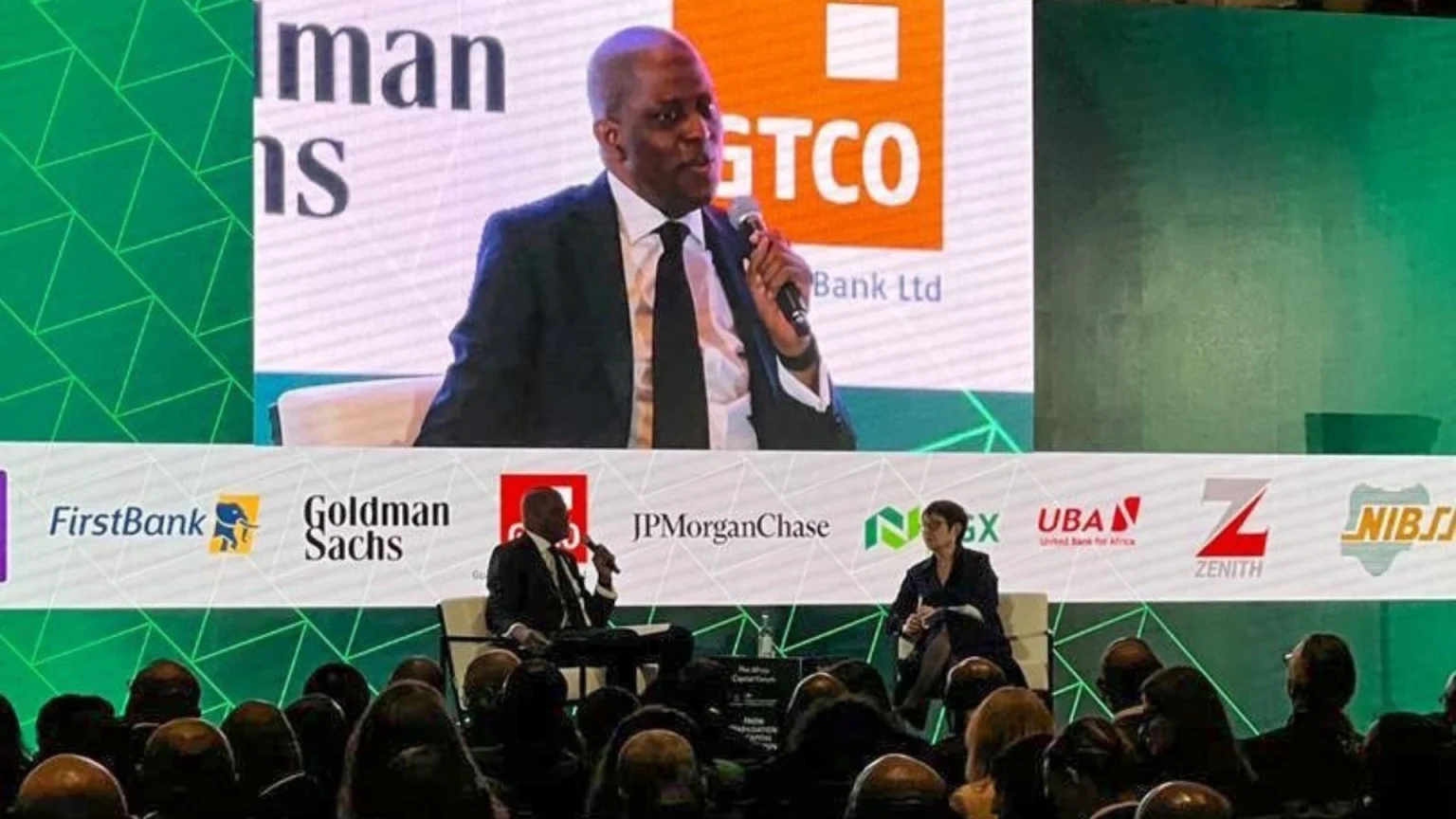
ABUJA: Senior executives from leading global financial institutions gathered in London for the Africa Capital Forum, a high-level meeting focused on unlocking long-term investment into Nigeria’s economy and strengthening confidence in Africa’s largest market.
The event, convened in partnership with the Central Bank of Nigeria (CBN), brought together policymakers, global investors, development finance institutions and senior leaders from Nigeria’s financial sector.
Held at The Peninsula London, the forum coincided with the state visit of Nigerian President Bola Tinubu to the United Kingdom and was designed to deepen international engagement with Nigeria’s economic reform agenda.
Participants included representatives from major global institutions such as J.P. Morgan, International Finance Corporation (IFC), and Standard Chartered, alongside development banks and private investors.
The forum was held under the theme From Stabilisation to Capital Mobilisation, reflecting a shift from crisis management to long-term investment growth in Nigeria.
The programme featured four sessions moderated by senior executives from J.P. Morgan and Standard Chartered and concluded with a fireside discussion between the Governor of the Central Bank of Nigeria, Olayemi Cardoso, and the President of the European Bank for Reconstruction and Development (EBRD), Odile Renaud‑Basso.
Cardoso used the forum to outline Nigeria’s economic recovery efforts, acknowledging that the country had recently faced one of the most severe financial crises in its history.
“Nigeria arguably has gone through one of its worst financial crises in the history of the country,” he said, pointing to inflation levels that reached 37 percent, excessive money supply and declining investor confidence.
According to him, the situation has since improved significantly following a series of policy adjustments.
“We have had 11 consistent months of disinflation and we are positive about the future,” the CBN governor noted.
Cardoso also described ongoing reforms within Nigeria’s financial system as transformative.
“The financial system we had is dead and buried. What we have now is a new system that has brought liquidity and transparency,” he said.
He further highlighted the growing international presence of Nigerian banks, describing them as ambassadors of the country’s financial sector across Africa and beyond.
“We are very proud of what Nigerian banks have been able to accomplish. They play a dominant role in Africa and beyond,” he added.
The forum also featured strong endorsements of Nigeria’s economic reforms from global institutions.
Speaking at the event, the British Deputy High Commissioner in Lagos, Jonny Baxter, emphasized the strong financial ties between Nigeria and the UK.
He noted that the United Kingdom accounts for nearly half of capital inflows into Nigeria, making London a natural venue for discussions on investment into the country.
The UK is proud to remain one of Nigeria’s partners with strong links in banking and capital markets, Baxter said.
Renaud-Basso of the European Bank for Reconstruction and Development also highlighted Nigeria’s potential for economic growth, citing its large population, growing technology sector and expanding markets.
“This open, transparent and predictable system is extremely important,” she said, expressing optimism about Nigeria’s reform direction.
CBN Deputy Governor for Economic Policy, Muhammad Sani Abdullahi, told participants that Nigeria’s macroeconomic indicators were improving following reforms introduced over the past two years.
He said foreign reserves had risen above $50 billion, while the foreign exchange market had stabilised and inflation had begun to decline.
“Today we have achieved stability,” Abdullahi said, although he noted that policymakers remain cautious about sustaining progress.
Independent analysts echoed this optimism.
Ravi Bhatia, director and lead analyst for Africa at S&P Global Ratings, confirmed that the rating agency had placed Nigeria on a positive outlook.
We put Nigeria on positive and we are positive, he said.
Several speakers at the forum stressed that Nigeria’s development requires patient, long-term capital rather than short-term portfolio investments.
Chris Chijiutomi, head of Africa at British International Investment, said long-term capital is crucial for sustainable growth and job creation in emerging markets.
Portfolio capital investors are good but long-term patient capital is more important,” he said.
Chijiutomi also emphasized the importance of strengthening domestic investment capacity, including the growth of pension funds and local capital markets.
The forum also examined the role of Nigeria’s banking sector in driving economic expansion.
Yemisi Edun, managing director and chief executive officer of First City Monument Bank (FCMB), said the ongoing bank recapitalisation programme had expanded lending capacity.
The raised capital has created expansion of credit,” she noted.
Similarly, the managing director of First Bank of Nigeria, Segun Alebiosu, said recent foreign exchange reforms would allow Nigerian banks to participate in larger international transactions.
Group Managing Director of United Bank for Africa (UBA), Oliver Alawuba, pointed out that more than 65 percent of the bank’s revenue now comes from outside Nigeria, demonstrating the sector’s growing continental footprint.
Another key discussion focused on how technology and financial innovation could help mobilise diaspora investment.
Luis Oganes, head of global markets research at J.P. Morgan, said Nigeria is increasingly emerging as a leading fintech ecosystem in sub-Saharan Africa.
The Group CEO of Nigerian Exchange Group, Temi Popoola, described the current period as a turning point for Nigeria’s capital markets.
“Technology has changed the face of our market,” he said, noting that growing investor flows were linked to reforms in the banking sector.
Odunayo Eweniyi, chief operating officer of the fintech platform PiggyVest, added that digital investment platforms are helping broaden financial inclusion.
We make investment feel much more accessible, she said.
In the final session, Managing Director of Access Bank, Roosevelt Ogbonna, acknowledged that reforms can sometimes generate fatigue among stakeholders but argued that Nigeria’s current reform programme enjoys greater credibility than in the past.
“For the first time there is congruence between fiscal and monetary policy,” he said.
Special Adviser to the President on Finance and Economy, Sanyade Okoli, also emphasised the importance of private capital in driving economic growth.
“The government alone cannot fund this growth. We need partners who will bring long-term equity capital,” she said.
Officials at the forum concluded that strengthening transparency, credible data and stable policy frameworks would remain critical to attracting sustained international investment into Nigeria.
The Africa Capital Forum is expected to continue serving as a platform for dialogue among global financial institutions, policymakers and investors seeking to shape the future of Africa’s financial markets and economic development.